Βιωσιμότητα τροφίμων

This page is also available in:

Τα τρόφιμα βρίσκονται στο κέντρο της ζωής μας, αποτελούν δε αναπόσπαστο κομμάτι του ευρωπαϊκού πολιτισμού. Ωστόσο, οι τροφές που καταναλώνουμε, ο τρόπος που τις παράγουμε και οι ποσότητες που σπαταλούνται έχουν μείζονα αντίκτυπο στην ανθρώπινη υγεία, τους φυσικούς πόρους και την κοινωνία στο σύνολό της:

  • Οι πολίτες –και ιδίως τα παιδιά– αντιμετωπίζουν ολοένα συχνότερα προβλήματα υπερβολικού βάρους και παχυσαρκίας λόγω ανθυγιεινής διατροφής.
  • Οι αγρότες και οι εργαζόμενοι δεν λαμβάνουν δίκαιη αμοιβή για τα προϊόντα τους.
  • Ένα τρίτο των τροφίμων χάνεται ή σπαταλάται κατά μήκος της αλυσίδας παραγωγής τους.
  • Το περιβάλλον υφίσταται τις συνέπειες, μέσω των δραματικών επιπτώσεων της παραγωγής και κατανάλωσης τροφίμων στην κλιματική αλλαγή, την απώλεια βιοποικιλότητας, τη ρύπανση του ατμοσφαιρικού αέρα και των υδάτων, την υποβάθμιση του εδάφους κλπ.

Η κρίση COVID-19 αποτελεί προειδοποίηση για την ανάγκη αλλαγής. Κατέστησε σαφές ότι η διαδρομή των τροφίμων από «το αγρόκτημα στο πιάτο» δεν μπορεί να θεωρείται δεδομένη, και κατέδειξε την αλληλοσύνδεση των φορέων και των δραστηριοτήτων σε ολόκληρο το σύστημα τροφίμων. Η ανάγκη για αλυσίδες εφοδιασμού δίκαιες, αποδοτικές ως προς τη χρήση των πόρων, χωρίς αποκλεισμούς και βιώσιμες, που θα καλύπτουν ολόκληρο τον τομέα της γεωργίας και των τροφίμων, είναι μεγαλύτερη από ποτέ, ώστε να ωφεληθούν ισότιμα οι πολίτες, οι γεωργοί, οι εργαζόμενοι και οι επιχειρήσεις.

Η ΕΟΚΕ πρωτοστατεί εδώ και χρόνια στην προώθηση μιας βιώσιμης και ολοκληρωμένης πολιτικής τροφίμων. Αυτή η ολοκληρωμένη και συστημική προσέγγιση είναι απαραίτητη για την αντιμετώπιση των πολλαπλών και διασυνδεδεμένων προκλήσεων που επηρεάζουν τα συστήματα τροφίμων· την επίτευξη οικονομικής, περιβαλλοντικής και κοινωνικοπολιτιστικής βιωσιμότητας· τη διασφάλιση της ολοκλήρωσης και της συνεκτικότητας μεταξύ των τομέων πολιτικής (όπως η γεωργία, το περιβάλλον, η υγεία, η παιδεία, το εμπόριο, η οικονομία, η τεχνολογία κλπ.)· και την προώθηση της συνεργασίας μεταξύ των διαφόρων επιπέδων διακυβέρνησης.
  • Εγκριθείσα on 21/09/2023 - Bureau decision date: 25/10/2022
    Έγγραφα αναφοράς
    NAT/884-EESC-2023
    Employers - GR I
    Estonia
    Plenary session number
    581
    -

    EESC opinion on Revision of EU marketing standards for agricultural products.

    Download format:
    Download — Γνωμοδότηση της ΕΟΚΕ: Revision of EU marketing standards for agricultural products
  • Εγκριθείσα on 22/03/2023 - Bureau decision date: 25/10/2022
    Έγγραφα αναφοράς
    NAT/888-EESC-2022
    Employers - GR I
    France
    Plenary session number
    577
    -
    Download format:
    Download — Γνωμοδότηση της ΕΟΚΕ: EU strategy on fertilisers
  • Εγκριθείσα on 14/12/2022 - Bureau decision date: 14/07/2022
    Έγγραφα αναφοράς
    NAT/873-EESC-2022
    Workers - GR II
    Germany
    Plenary session number
    574
    -

    Considering the extent of the food security crisis and the urgency to address the issue of excessive commodity speculation, the aim of this own-initiative opinion is to analyse the current situation in more detail; gather experts' views on the impacts of commodity speculation on food price increases and food security worldwide; and provide civil society's recommendations on policy measures that are needed to address excessive price speculation and increase market transparency.

    Download format:
    Download — Γνωμοδότηση της ΕΟΚΕ: Food price crisis: the role of speculation and concrete proposals for action in the aftermath of the Ukraine war
    • Presentation by Agnès Popelin Desplanches - Opinion: For a national public environmental health policy at the heart of the territories
    • Presentation by Éloi Laurent - Full health on a living planet
    • Presentation by Pietro Stella - One health in EFSA
  • The role of civil society

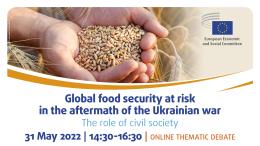
    This thematic debate aims to discuss the impacts of the war on food security worldwide, with a focus on some specific world regions; further actions that will be needed to ensure food security while fostering resilient and sustainable food systems and the role civil society can play in ensuring food security both in Europe and beyond.

  • Published in
    14 pages

    Between June 2021 and March 2022, the EESC held a series of events on the updated new industrial strategy. Each event was organised by a different section of the EESC and focused on a specific aspect of the strategy, with the aim of hearing the views of civil society organisations on the future of European industry.

  • Consumers and Environment Category
    Event type
    Conference

    The aim of the conference is to look at how the European Union can be more active in this area, especially through better cooperation among the key stakeholders. The conference will take place in a hybrid format.

  • EU organic awards
    Reference number
    6/2022

    Today, as a true pan-European collaborative venture, the European Commission, the European Economic and Social Committee (EESC), the European Committee of the Regions (CoR), COPA-COGECA and IFOAM Organics Europe are together launching the first ever EU organic awards. These awards will recognise excellence along the organic value chain, rewarding the best and most innovative actors in organic production in the EU. Applications will be open from 25 March until 8 June 2022.