Elintarvikehuollon kestävyys

This page is also available in:

Ruualla on keskeinen sija elämässämme, ja se on olennainen osa eurooppalaista kulttuuria. Syömämme ruoka, elintarvikkeiden tuotantotavat ja hävikin määrä vaikuttavat kuitenkin merkittävästi ihmisten terveyteen, luonnonvaroihin ja koko yhteiskuntaan:

  • Yhä useammat ihmiset – erityisesti lapset – kärsivät ylipainosta ja lihavuudesta epäterveellisen ruokavalion vuoksi.
  • Maataloustuottajat ja työntekijät eivät saa tuotteista oikeudenmukaista hintaa.
  • Kolmannes elintarvikkeista menee hukkaan tai haaskataan elintarvikeketjun eri vaiheissa.
  • Ympäristö joutuu kärsimään dramaattisista vaikutuksista, joita elintarvikkeiden tuotannolla ja kulutuksella on ilmastonmuutokseen, biologisen monimuotoisuuden köyhtymiseen, ilman ja veden saastumiseen, maaperän huonontumiseen jne.

Covid-19-pandemia on herättänyt huomaamaan muutoksen tarpeen. Se on osoittanut, ettei ruuan saamista ”pellolta pöytään” voida pitää itsestäänselvyytenä ja että koko elintarvikejärjestelmän toimijat ja toiminta ovat sidoksissa toisiinsa. Kaikkialla maatalous- ja elintarvikealalla on nyt välttämättömämpää kuin koskaan huolehtia oikeudenmukaisista, resurssitehokkaista, osallistavista ja kestävistä toimitusketjuista niin kansalaisten, maataloustuottajien, työntekijöiden kuin yritystenkin hyväksi.

ETSK on jo vuosia ollut eturintamassa vaatimassa kestäväpohjaista ja kattavaa elintarvikepolitiikkaa. Tällainen yhdennetty, koko järjestelmää koskeva lähestymistapa on välttämätön, jotta voidaan vastata elintarvikejärjestelmiin vaikuttaviin moninaisiin ja toisiinsa kytkeytyviin haasteisiin, huolehtia taloudellisesta, ympäristöön liittyvästä ja sosiokulttuurisesta kestävyydestä, varmistaa eri politiikanalojen (maatalous, ympäristö, terveys, koulutus, kauppa, talous, teknologia jne.) linkittyminen ja johdonmukaisuus sekä edistää eri hallintotasojen yhteistyötä.
  • Hyväksytyt on 21/09/2023 - Bureau decision date: 25/10/2022
    Viite
    NAT/884-EESC-2023
    Employers - GR I
    Estonia
    Plenary session number
    581
    -

    EESC opinion on Revision of EU marketing standards for agricultural products.

    Download format:
    Download — ETSK:n lausunto: Revision of EU marketing standards for agricultural products
  • Hyväksytyt on 22/03/2023 - Bureau decision date: 25/10/2022
    Viite
    NAT/888-EESC-2022
    Employers - GR I
    France
    Plenary session number
    577
    -
    Download format:
    Download — ETSK:n lausunto: EU strategy on fertilisers
  • Hyväksytyt on 14/12/2022 - Bureau decision date: 14/07/2022
    Viite
    NAT/873-EESC-2022
    Workers - GR II
    Germany
    Plenary session number
    574
    -

    Considering the extent of the food security crisis and the urgency to address the issue of excessive commodity speculation, the aim of this own-initiative opinion is to analyse the current situation in more detail; gather experts' views on the impacts of commodity speculation on food price increases and food security worldwide; and provide civil society's recommendations on policy measures that are needed to address excessive price speculation and increase market transparency.

    Download format:
    Download — ETSK:n lausunto: Food price crisis: the role of speculation and concrete proposals for action in the aftermath of the Ukraine war
    • Presentation by Agnès Popelin Desplanches - Opinion: For a national public environmental health policy at the heart of the territories
    • Presentation by Éloi Laurent - Full health on a living planet
    • Presentation by Pietro Stella - One health in EFSA
  • The role of civil society

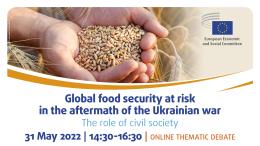
    This thematic debate aims to discuss the impacts of the war on food security worldwide, with a focus on some specific world regions; further actions that will be needed to ensure food security while fostering resilient and sustainable food systems and the role civil society can play in ensuring food security both in Europe and beyond.

  • Published in
    14 pages

    Between June 2021 and March 2022, the EESC held a series of events on the updated new industrial strategy. Each event was organised by a different section of the EESC and focused on a specific aspect of the strategy, with the aim of hearing the views of civil society organisations on the future of European industry.

  • Consumers and Environment Category
    Event type
    Conference

    The aim of the conference is to look at how the European Union can be more active in this area, especially through better cooperation among the key stakeholders. The conference will take place in a hybrid format.

  • EU organic awards
    Reference number
    6/2022

    Today, as a true pan-European collaborative venture, the European Commission, the European Economic and Social Committee (EESC), the European Committee of the Regions (CoR), COPA-COGECA and IFOAM Organics Europe are together launching the first ever EU organic awards. These awards will recognise excellence along the organic value chain, rewarding the best and most innovative actors in organic production in the EU. Applications will be open from 25 March until 8 June 2022.