Duurzame voeding

This page is also available in:

Voedsel staat centraal in ons leven en maakt integraal deel uit van de Europese cultuur. Het voedsel dat we eten, de manier waarop we het produceren en de hoeveelheid die we verspillen hebben echter grote gevolgen voor de menselijke gezondheid, de natuurlijke hulpbronnen en de samenleving als geheel:

  • Steeds meer burgers — met name kinderen — kampen met overgewicht en obesitas als gevolg van ongezonde voedingspatronen.
  • Landbouwers en werknemers krijgen geen eerlijke prijs voor hun producten.
  • Een derde van al het voedsel gaat verloren of wordt verspild in de voedselketen.
  • Het milieu betaalt hiervoor een hoge tol: de voedselproductie en -consumptie heeft een enorme impact op klimaatverandering, verlies van biodiversiteit, lucht- en waterverontreiniging, bodemdegradatie enz.

De COVID-19-crisis heeft ons wakker geschud en laten zien dat het tijd is voor verandering. Eens te meer bleek dat we het traject van boer tot bord niet voor lief moeten nemen en dat alle actoren en activiteiten in het hele voedselsysteem nauw met elkaar verweven zijn. Eerlijke, hulpbronnenefficiënte, inclusieve en duurzame toeleveringsketens in de hele landbouw- en levensmiddelensector zijn meer dan ooit nodig om in gelijke mate tegemoet te komen aan de behoeften van burgers, landbouwers, werknemers en bedrijven.

Het EESC pleit al jaren prominent voor een duurzaam en alomvattend voedselbeleid. Een dergelijke geïntegreerde en systemische aanpak is van essentieel belang om de talrijke en onderling samenhangende uitdagingen aan te pakken die van invloed zijn op voedselsystemen; om te zorgen voor economische, ecologische en sociaal-culturele duurzaamheid; om te zorgen voor integratie en samenhang tussen beleidsterreinen (zoals landbouw, milieu, gezondheid, onderwijs, handel, economie, technologie, enz.; en om samenwerking tussen bestuurslagen te bevorderen.
  • Goedgekeurd on 21/09/2023 - Bureau decision date: 25/10/2022
    Referentie
    NAT/884-EESC-2023
    Employers - GR I
    Estonia
    Plenary session number
    581
    -

    EESC opinion on Revision of EU marketing standards for agricultural products.

    Download format:
    Download — advies EESC: Revision of EU marketing standards for agricultural products
  • Goedgekeurd on 22/03/2023 - Bureau decision date: 25/10/2022
    Referentie
    NAT/888-EESC-2022
    Employers - GR I
    France
    Plenary session number
    577
    -
    Download format:
    Download — advies EESC: EU strategy on fertilisers
  • Goedgekeurd on 14/12/2022 - Bureau decision date: 14/07/2022
    Referentie
    NAT/873-EESC-2022
    Workers - GR II
    Germany
    Plenary session number
    574
    -

    Considering the extent of the food security crisis and the urgency to address the issue of excessive commodity speculation, the aim of this own-initiative opinion is to analyse the current situation in more detail; gather experts' views on the impacts of commodity speculation on food price increases and food security worldwide; and provide civil society's recommendations on policy measures that are needed to address excessive price speculation and increase market transparency.

    Download format:
    Download — advies EESC: Food price crisis: the role of speculation and concrete proposals for action in the aftermath of the Ukraine war
    • Presentation by Agnès Popelin Desplanches - Opinion: For a national public environmental health policy at the heart of the territories
    • Presentation by Éloi Laurent - Full health on a living planet
    • Presentation by Pietro Stella - One health in EFSA
  • The role of civil society

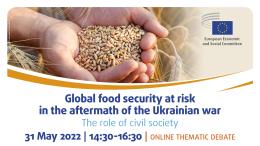
    This thematic debate aims to discuss the impacts of the war on food security worldwide, with a focus on some specific world regions; further actions that will be needed to ensure food security while fostering resilient and sustainable food systems and the role civil society can play in ensuring food security both in Europe and beyond.

  • Published in
    14 pages

    Between June 2021 and March 2022, the EESC held a series of events on the updated new industrial strategy. Each event was organised by a different section of the EESC and focused on a specific aspect of the strategy, with the aim of hearing the views of civil society organisations on the future of European industry.

  • Consumers and Environment Category
    Event type
    Conference

    The aim of the conference is to look at how the European Union can be more active in this area, especially through better cooperation among the key stakeholders. The conference will take place in a hybrid format.

  • EU organic awards
    Reference number
    6/2022

    Today, as a true pan-European collaborative venture, the European Commission, the European Economic and Social Committee (EESC), the European Committee of the Regions (CoR), COPA-COGECA and IFOAM Organics Europe are together launching the first ever EU organic awards. These awards will recognise excellence along the organic value chain, rewarding the best and most innovative actors in organic production in the EU. Applications will be open from 25 March until 8 June 2022.