The opinion examines the possible introduction of a new concept into EU law: "low-profit". This concept would define all organisations that are likely to make a profit but that do not intend to distribute it to their owners or shareholders, as they have a different purpose.
Download — Opinia EKES-u: Towards an appropriate European legal framework for social economy enterprises (own-initiative opinion)
Making a reality of the European Pillar of Social Rights (the "Social Pillar") will require improvements in Member States and a robust budgetary base, investment and current spending.
More public investment within Member States can be facilitated by reference to a Golden Rule for public investment with a social objective, which would allow more flexibility in budget rules with a view to achieving the aims of the European Pillar of Social Rights. More public investment can also be supported by the use of existing EU instruments, especially the European Structural and Investment Funds (ESIFs), and by the European Fund for Strategic Investments (EFSI). This support should explicitly include objectives linked to the Social Pillar.
Download — Opinia EKES-u: Funding the European Pillar of Social Rights (own-initiative opinion)
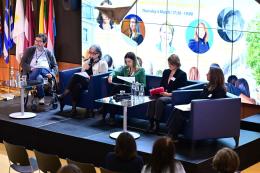
To mark International Women’s Day 2026, the European Economic and Social Committee (EESC) hosted a panel discussion highlighting the essential but undervalued work carried out largely by women across Europe. The event, held at the close of Civil Society Week, examined how invisible work supports families, communities, and entire economies, yet too often remains unrecognised, unprotected and uncompensated.
Gender stereotypes continue to be perpetuated and amplified by contemporary media, particularly in the digital sphere. At a conference organised by the European Economic and Social Committee (EESC), speakers called for stronger use of EU legal instruments to address the repression of female journalists, both online and offline.
At its January 2026 plenary session, the European Economic and Social Committee (EESC) adopted a resolution outlining the EU’s priorities for the 70th United Nations Commission on the Status of Women (UN CSW70). With a strong focus on access to justice, women’s participation in public life and the elimination of gender‑based violence, the EESC sets out a roadmap to strengthen women’s rights and reinforce democracy across Europe and beyond.
At its January 2026 plenary session, the European Economic and Social Committee (EESC) adopted an opinion calling for a significantly strengthened European Social Fund (ESF) within the future National and Regional Partnership Plans (NRPPs). The Committee argues that the ESF must play a central role in ensuring quality jobs, lifelong learning, social inclusion and equal opportunities for all during the 2028–2034 programming period.
The European Economic and Social Committee (EESC) adopted its opinion on the European Citizens’ Initiative (ECI) My Voice, My Choice: For Safe and Accessible Abortion during its January plenary session, following a debate that underscored that abortion is a fundamental human right that must be protected for every woman.
At its December 2025 plenary session, the European Economic and Social Committee (EESC) adopted an opinion supporting the European Commission’s proposals for the AgoraEU and Justice programmes for 2028–2034. The EESC calls for robust support for civil society, enhanced democratic participation, and a stronger European Area of Justice, in the pursuit of a free and democratic Europe.
At its December 2025 plenary session, the European Economic and Social Committee (EESC) adopted an own-initiative opinion calling for urgent action to strengthen labour rights for journalists and media professionals across Europe. The EESC’s message is clear: decent working conditions are essential to safeguard the independence of journalism and ensure citizens’ access to reliable, pluralist, and truthful information.