
European Economic
and Social Committee
Invisible work, visible impact: recognising the women who sustain our societies
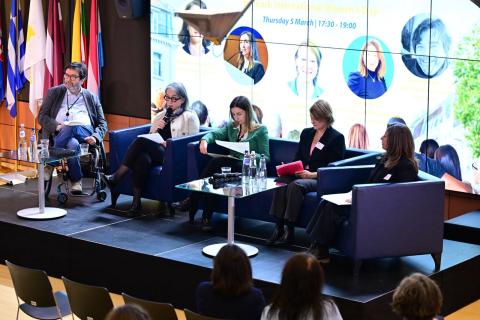
To mark International Women’s Day 2026, the European Economic and Social Committee (EESC) hosted a panel discussion highlighting the essential but undervalued work carried out largely by women across Europe. The event, held at the close of Civil Society Week, examined how invisible work supports families, communities, and entire economies, yet too often remains unrecognised, unprotected and uncompensated.
The discussion, “Invisible work, visible impact" brought together civil society representatives and experts working on gender equality, migration and long‑term care. Moderated by Pietro Barbieri (an EESC Member who has worked extensively on the topic of carers and migration, and who spoke of his personal experience as someone who needs care assistance), the panel explored the structural drivers that keep such work invisible and the policies needed to ensure dignity, fairness and respect for the women performing it.
Opening the event, EESC President Séamus Boland stressed that invisible work is not only a gender issue but fundamentally a question of dignity and societal values: “The title of this discussion draws attention to the absence of respect and the absence of dignity afforded to women – often migrant women – whose work is taken for granted, ignored and undervalued in our societies. It is a very timely debate, on a topic that is not often discussed in the context of International Women’s Day.”
His remarks reflected one of the central concerns of Civil Society Week: strengthening social cohesion and ensuring no one is left behind, particularly those whose contributions remain hidden despite their essential nature.
Invisible care: economic contribution without rights
The first speaker, EESC Member Marie-Pierre Le Breton, highlighted the enormous economic value of unpaid and informal care work – most of it performed by women. Drawing on data she presented during the panel, she underscored that invisible work underpins Europe’s care systems and broader economic stability.
She warned that despite its indispensability, informal care frequently results in isolation, financial hardship, deteriorating mental and physical health, and reduced employment opportunities for the women who provide it.
Her central message was clear: “Awareness remains insufficient. Women’s invisible work is still largely overlooked. Without it, the life balance and choices of hundreds of thousands of vulnerable, disabled, sick and elderly people would collapse. This must be addressed through stronger policies and targeted support measures. This is why today’s discussion matters.”
Migrant women: essential workers in undervalued sectors
EESC Member Nicoletta Merlo focused on the vital but undervalued work carried out by migrant women, particularly in domestic work, cleaning, care and hospitality – sectors where overqualification is common and recognition of skills insufficient.
She shared concrete examples of migrant women arriving with nursing degrees or other professional qualifications that are not recognised, forcing them into lower-paid work despite urgent labour shortages in care systems across Europe.
Her reflections echoed key EESC opinions on caregivers, labour migration and care workers’ rights, stressing the need for improved recognition of qualifications, legal pathways, and stronger enforcement of labour protections.
“How do we make invisible work, visible? Through better protection to combat abuse and exploitation; by improving pay to compensate fairly this type of hard and difficult work and making it more attractive to non-migrants; by beating stereotypes and sexism and recruiting more men to do this type of work” she explained.
The long-term perspective
Representing Eurocarers, Shannon Pfohman broadened the discussion to the long-term care sector, noting that both unpaid carers and migrant care workers uphold entire care systems yet remain undervalued and invisible.
Drawing on Eurocarers’ “Invisible No More” campaign, she described how migrant women often work in precarious, isolated conditions with limited rights and recognition, despite being central to meeting Europe’s growing care needs.
She stressed that care must be understood as societal infrastructure, requiring investment, regulation and long-term planning rather than being treated as a private household responsibility.
Closing the round of interventions, Frohar Poya of the European Network of Migrant Women provided an intersectional perspective, highlighting how migrant women face multiple, overlapping obstacles – from legal barriers and unrecognised qualifications to discrimination and policy blind spots.
She emphasised that migrant women’s contributions are vital yet systematically overlooked in policy design, noting that many remain excluded from employment, childcare, and integration services that would allow them to thrive and contribute fully to society.
Her message reinforced the need for gender‑responsive migration and labour policies, better data collection, and targeted support to address the “invisible losses” caused by systemic exclusion.
Towards visibility, fairness and dignity
The panel concluded with a clear understanding shared by all speakers: invisible work sustains Europe’s societies, economies and care systems. Yet the women who perform this work – often migrant women – continue to face undervaluation, discrimination, exploitation and a lack of protection.
By bringing these realities to light, the EESC sends a strong message for International Women’s Day: visibility is the first step toward justice. The Committee will continue using its platform, opinions and engagement with civil society to support fair working conditions, improved recognition of care work, and stronger pathways to inclusion for migrant and informal workers – ensuring that the visible impact of invisible work is matched by therights, respect, recognition and finally, the dignity it deserves.
Work organisation
Recommended for you
Invisible Work, Visible Impact
Agenda
Making the Invisible Visible: Recognising the Hidden Work that Sustains Our SocietyEvery day, our societies run on invisible work - the essential tasks that often go unnoticed and undervalued. It’s…
Supporting parenting students in higher education: making invisible students visible
Article
<< Back to BulletinAcross Europe, increasing attention is being paid to widening participation in higher education and supporting diverse student populations. Yet one group often remains…
Violence against women must be recognised as an EU crime
News
At its July plenary, the European Economic and Social Committee (EESC) debated the Commission's draft directive to tackle gender-based violence and gender equality in presence of Cristina Fabre of…
Evelyn Regner: the liberal professions are an essential part of our society
News
On 10 May, the vice-president of the European Parliament Evelyn Regner took part in the European Day of the Liberal Professions 2022, which was hosted by the Liberal Professions Category of the…
Meet our members | Branko RAVNIK : towards fair and sustainable food systems
News
Branko RAVNIK has been a member of the EESC since 2015, as part of the Civil Society Organisations’ Group. He is currently Senior Agriculture Adviser of the Institute for the Promotion…