The EESC welcomes the proposal to use the passerelle clauses to establish a qualified majority in the Council and a co-decision system with the European Parliament. In this new set-up, the EESC could play an important role in supporting the trilogue and should be involved.
Download — Parere del CESE: New institutional framework for energy and climate policy by 2025
The opinion examines the possible introduction of a new concept into EU law: "low-profit". This concept would define all organisations that are likely to make a profit but that do not intend to distribute it to their owners or shareholders, as they have a different purpose.
Download — Parere del CESE: Towards an appropriate European legal framework for social economy enterprises (own-initiative opinion)
Making a reality of the European Pillar of Social Rights (the "Social Pillar") will require improvements in Member States and a robust budgetary base, investment and current spending.
More public investment within Member States can be facilitated by reference to a Golden Rule for public investment with a social objective, which would allow more flexibility in budget rules with a view to achieving the aims of the European Pillar of Social Rights. More public investment can also be supported by the use of existing EU instruments, especially the European Structural and Investment Funds (ESIFs), and by the European Fund for Strategic Investments (EFSI). This support should explicitly include objectives linked to the Social Pillar.
Download — Parere del CESE: Funding the European Pillar of Social Rights (own-initiative opinion)
During its June plenary session, the European Economic and Social Committee (EESC) adopted an opinion evaluating the implementation of the EU Whistleblower Protection Directive, warning that significant gaps remain between legal protections and their practical application. The Committee calls for stronger safeguards against retaliation, better support for whistleblowers, greater involvement of civil society and a cultural shift that sees whistleblowing as a contribution to democracy, transparency and the public interest.
At its April 2026 plenary session, the European Economic and Social Committee (EESC) adopted an exploratory opinion on EU competitiveness and youth entrepreneurship. Requested by the Cyprus Presidency of the Council of the EU, the opinion sets out how supporting young entrepreneurs can strengthen innovation, foster sustainable growth and help secure the future of Europe’s SMEs.
The European Economic and Social Committee (EESC) placed fundamental rights, dignity and equality at the centre of its April plenary session, holding a high‑level debate on Union of Equality: Advancing LGBTIQ+ rights and banning conversion practices. The debate was followed by the adoption of two key EESC opinions calling for stronger enforcement of the EU’s LGBTIQ+ Equality Strategy 2026–2030 and a comprehensive EU‑wide ban on conversion practices.
At its March 2026 plenary session, the European Economic and Social Committee (EESC) adopted an exploratory opinion on how to ensure social inclusion and independent living for persons with disabilities through high‑quality, specialised social services. Building on the UN Convention on the Rights of Persons with Disabilities (UNCRPD), the Strategy for the Rights of Persons with Disabilities 2021–2030, and years of civil‑society advocacy, the Committee sets out a clear roadmap to close the gap between commitments and reality.
At its March 2026 plenary session, the European Economic and Social Committee (EESC) adopted an exploratory opinion addressing how artificial intelligence and algorithmic management are reshaping work across Europe. Building on the Committee’s long‑standing engagement with social and employment policies, the opinion outlines a roadmap to ensure that AI strengthens workers’ rights, enhances job quality and supports a fair, competitive and inclusive digital transformation.
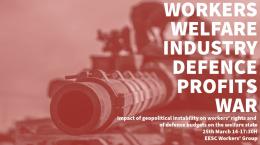
On 25th of March, the EESC Workers’ Group gathered together with a number of guest speakers from academia, trade unions and MEPs from the European Parliament, to discuss the current geopolitical situation, its impact on social and defence expenditure, its spillovers on supply chains and industry, and the consequences for the welfare states and workers’ rights.