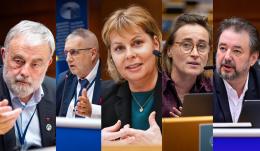
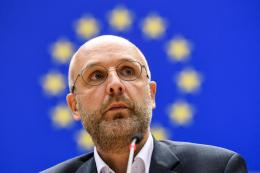
From breaking intergenerational disadvantage and tackling child poverty to ending homelessness and protecting civic space, the European Economic and Social Committee (EESC) is calling for a comprehensive, rights-based approach to poverty. Key opinions adopted during its October plenary underline one central message: lasting solutions must be shaped with the support of civil society and the people most affected.
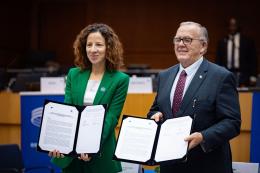
The European Economic and Social Committee (EESC) and the European Commission signed a Memorandum of Understanding to strengthen their cooperation in the fight against poverty and social exclusion. EESC President Séamus Boland, EU policymakers, civil society representatives, social partners and people with lived experience of poverty discussed how Europe can accelerate progress towards eradicating poverty by 2050 at a debate hosted by the EESC.
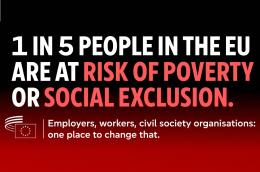
Poverty is not simply a lack of income. It can mean being unable to afford food, heating, healthcare or secure housing, or to participate fully in society. To mark the International Day for the Eradication of Poverty, the European Economic and Social Committee (EESC) highlights its longstanding call for coordinated European action to tackle its many interconnected causes.
We, at the EESC Workers’ Group, express our full solidarity with the Irish trade unions and the hundreds of thousands of public sector workers, taking industrial action to demand fair pay and decent working conditions. We salute the massive participation from all sectors in what is shaping up to be the biggest day of nationwide industrial action since 2008.
The European Union must ensure that today’s political choices do not lead to further inequalities or leave future generations carrying an unfair share of the costs. This is the central message of an opinion adopted by the European Economic and Social Committee (EESC), which calls for intergenerational fairness to become a measurable principle embedded across all EU policies.
Responsibility for preventing cyberbullying must rest primarily with digital platforms rather than with children and young people. This is the central message of a new opinion in which the European Economic and Social Committee (EESC) calls for stronger platform accountability, straightforward reporting procedures and meaningful youth participation in the fight against harmful online behaviour.
Europe’s response to terrorism and violent extremism must combine effective security measures with prevention, democratic resilience and the systematic involvement of civil society. This is the central message of an opinion adopted by the European Economic and Social Committee (EESC), which warns that security measures alone cannot address the complex and interconnected threats facing the EU.
Public services should not primarily be regarded as a cost to public finances, but as a strategic investment in democracy, social cohesion, economic development and the functioning of the EU. This is the core message of an opinion adopted by the European Economic and Social Committee (EESC) on how the sector can adapt to new challenges in the EU.
With the UN's targets still off track for 2030, the European Economic and Social Committee (EESC) is calling for faster action. In a Resolution on the EU's priorities for 71st session of the United Nations Commission on the Status of Women (UN CSW71), the Committee highlights persistent barriers to women's economic independence and leadership, widespread gender-based violence and the need for stronger cooperation between EU institutions, Member States, social partners and civil society.
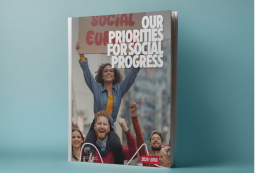
The document highlights the Worker's Group priorities for 2025-2030. Our work is proposing or updating policies to improve the European project that would ensure growth and social sustainability, would have an effect on rebuilding the bond of trust between our workers, the citizens, across our Member States and the European Institutions. It is a roadmap for renewal. It challenges us to think boldly about the future or our movement and reminds us that our strength has always been our ability to adapt without abandoning our core values of solidarity, social progress and social justice.