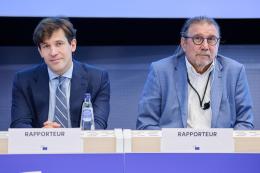
The EESC welcomes the proposal to use the passerelle clauses to establish a qualified majority in the Council and a co-decision system with the European Parliament. In this new set-up, the EESC could play an important role in supporting the trilogue and should be involved.
Download — EMSK arvamus: New institutional framework for energy and climate policy by 2025
The opinion examines the possible introduction of a new concept into EU law: "low-profit". This concept would define all organisations that are likely to make a profit but that do not intend to distribute it to their owners or shareholders, as they have a different purpose.
Download — EMSK arvamus: Towards an appropriate European legal framework for social economy enterprises (own-initiative opinion)
Making a reality of the European Pillar of Social Rights (the "Social Pillar") will require improvements in Member States and a robust budgetary base, investment and current spending.
More public investment within Member States can be facilitated by reference to a Golden Rule for public investment with a social objective, which would allow more flexibility in budget rules with a view to achieving the aims of the European Pillar of Social Rights. More public investment can also be supported by the use of existing EU instruments, especially the European Structural and Investment Funds (ESIFs), and by the European Fund for Strategic Investments (EFSI). This support should explicitly include objectives linked to the Social Pillar.
Download — EMSK arvamus: Funding the European Pillar of Social Rights (own-initiative opinion)
Gender equality is not only a fundamental EU value, but also a driver of economic growth, competitiveness and democratic resilience, the European Economic and Social Committee (EESC) says in its opinion on the Gender Equality Strategy 2026-2030, adopted during its July plenary session.
Europe's migration policy must be built on rights, integration and legal pathways, not just border controls and returns, the European Economic and Social Committee (EESC) says in its opinion on the European Migration and Asylum Strategy, adopted during its July plenary session.
Civil society organisations, individuals and private companies can now enter their non-profit projects for the EESC’s prize dedicated to combating poverty in the EU.
The fight against racism in Europe must move beyond good intentions and become a genuine political priority, the European Economic and Social Committee says in its recently adopted opinion on the EU Anti-Racism Strategy 2026-2030.
The European Economic and Social Committee (EESC) held a plenary debate with European Commission Executive Vice-President, Roxana Mînzatu, on how better protection for workers can strengthen Europe’s competitiveness. The debate focused on quality jobs and fair labour mobility, and was followed by the adoption of two related EESC opinions.
As the world celebrates the International Volunteer Year 2026 (IVY 2026), experts from across Europe gathered at an EESC hearing to underline the vital contribution that volunteers make to building resilient, prepared and cohesive societies. The hearing, organised as part of the EESC's work on the forthcoming opinion on the role of volunteering for European preparedness, explored how volunteering strengthens communities before, during and after crises.