
European Economic
and Social Committee
EESC gives full support to My Voice, My Choice initiative
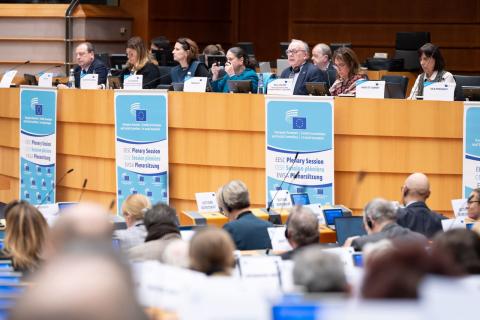
The European Economic and Social Committee (EESC) adopted its opinion on the European Citizens’ Initiative (ECI) My Voice, My Choice: For Safe and Accessible Abortion during its January plenary session, following a debate that underscored that abortion is a fundamental human right that must be protected for every woman.
During its January plenary session, the EESC endorsed the proposal for an EU solidarity mechanism enabling women who cannot access abortion in their home country to obtain care in another Member State. Following a debate, the opinion was adopted with broad support, underscoring the Committee’s commitment to protecting women’s bodily autonomy and ensuring equal access to reproductive healthcare across the EU.
‘Ensuring that rights and services are not only guaranteed in principle, but accessible in practice, lies at the heart of social justice and political responsibility. This is precisely where civil society plays a vital role,’ said EESC President Séamus Boland. ‘This debate offers an important opportunity to reflect on the role of the EU, its institutions and civil society in addressing complex and sensitive societal challenges.’
Closing the gaps in access to abortion
The debate highlighted ongoing disparities in abortion access across Europe. While some Member States ensure comprehensive services, others impose restrictive laws, procedural obstacles or lack adequate healthcare provision. In countries where abortion is criminalised or heavily limited, many women must travel abroad – often only possible for those with sufficient financial means – while others risk unsafe procedures or are forced to continue pregnancies against their will.
Nika Kovač, speaking for the organisers of My Voice, My Choice, described the realities faced by millions of women across the EU who lack safe and accessible abortion services, urging members to support the ECI and reject the status quo: ‘As a citizen you often hear there is nothing you can do, but we proved that this is not true’.
Deputy Director‑General at DG JUST, Irena Moozová, outlined the Commission’s ongoing evaluation of the ECI and referenced broader EU action under the Gender Equality Strategy, and reminded participants that the European Commission is expected to set out its legal and political conclusions on the ECI by 2 March, in a Communication which will spell out which actions the Commission intends to take to follow-up on the Initiative.
Member of the European Parliament’s Committee on Women’s Rights and Gender Equality (FEMM), Abir Al-Sahlani, highlighted that ‘history was made’ on 17 December 2025, when the European Parliament adopted a resolution on the ECI, while Secretary-General of the European Women’s Lobby, Mary Collins, drew attention to the current backlash against women’s reproductive rights being witnessed around the globe and the need to fight it, through initiatives such as My Voice, My Choice and through the fight against disinformation.
EESC rapporteur José Antonio Moreno Díaz echoed these views, stating that: ‘The EESC opinion fully supports the My Voice, My Choice initiative, which recognises the right to abortion as a woman’s right to privacy, integrity, sexuality, personal autonomy and, ultimately, health, while also guaranteeing that it can be exercised in safe conditions.’
Backing the creation of an EU financial mechanism to cover costs
Supported by more than 1.2 million verified signatures, My Voice, My Choice calls for an EU financial mechanism that would cover the costs of abortion care for women who cannot access services at home. This voluntary, opt‑in solidarity mechanism would respect national competences while providing concrete support to Member States offering cross‑border care.
The EESC echoed this proposal in its opinion, stressing that women’s rights must not depend on income level, social background or geography. The Committee also pointed out that obstructing access to abortion may constitute institutional gender‑based violence, in line with the Istanbul Convention and EU Directive 2024/1385.
Towards EU‑level protection of reproductive rights
In adopting its opinion, the EESC emphasised that access to safe and legal abortion is closely tied to fundamental rights such as health, integrity, privacy, equality and freedom from inhuman or degrading treatment. It stressed that the decision to end a pregnancy must rest solely with the woman concerned, and that sexual and reproductive health and rights are firmly rooted in EU obligations under the Treaties and the Charter of Fundamental Rights. Meaningful access, the Committee noted, depends on comprehensive sex education, adequate healthcare and efforts to counter stigma, alongside stronger data collection by the European Institute for Gender Equality (EIGE) and Eurostat and better protection for civil society, healthcare professionals and women facing intimidation.
Closing the debate, members reiterated that the EU must act to ensure no woman is left without safe abortion care. The Committee urged the European Commission to swiftly propose legislation enabling Member States to provide cross‑border abortion services supported by EU financing.
Quotes from the rapporteur and groups
‘The EESC opinion fully supports the My Voice, My Choice initiative, which recognises the right to abortion as a woman’s right to privacy, integrity, sexuality, personal autonomy and, ultimately, health, while also guaranteeing that it can be exercised in safe conditions. We hope that the Commission will shoulder its responsibility, listen to civil society, take note of this initiative and today’s debate and seize the initiative to design an EU policy instrument that facilitates access to abortion rights for all women in the EU.’
José Antonio Moreno Díaz, EESC rapporteur and member of the EESC’s Workers’ Group
‘Abortion is not only a question of healthcare, it is a question of human rights. We call on the European Commission to provide concrete support, including financial mechanisms for Member States, that ensure access to safe abortion care. We also urge for better data, more comprehensive sex education, and the protection of healthcare providers and activists who make this right a reality every day.’
Christa Schweng, member of the EESC’s Employers’ Group and former President of the EESC
‘When access to abortion depends on where you live, equality fails. This is about dignity, equality, and justice. Europe must guarantee genuine access, not just rights on paper. It is time for political courage.’
Juliane Marie Neiiendam, Vice-President of the EESC’s Civil Society Organisations’ Group and representative of the Women’s Council in Denmark