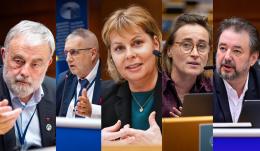
Is Europe condemned to keep pushing the same rule of law boulder uphill, only to watch it roll back down? At the EESC's seventh annual conference on fundamental rights and the rule of law, civil society and EU representatives called for stronger follow-up to identified shortcomings, as the EU considers a closer link between rule of law recommendations and funding under its next long-term budget.
Better jobs can mean a stronger economy. At the Socio-Economic Value of Job Quality conference, jointly organised by the European Commission and the EESC, findings from the European Employment and Social Outlook 2026 highlighted the links between job quality, productivity and economic resilience. Against this backdrop, the EESC is calling for a comprehensive approach combining fair wages, secure employment, skills, safe working conditions and strong social dialogue.
As the EU conducts its regular revision of its employment guidelines, the European Economic and Social Committee (EESC) stresses that the rights of workers must not be jeopardised amid a push to prioritise deregulation. Ensuring the security and fair treatment of workers is particularly relevant when dealing with the increasing prevalence of AI systems, complex subcontracting and gender imbalances in the workplace.
As Europe marks Gender Equality Week 2026, the European Economic and Social Committee (EESC) is highlighting its long-standing commitment to advancing gender equality through its most recent policy work, civil society engagement and international action. From equal pay and economic independence to reproductive rights, participation and the fight against gender-based violence, the Committee continues to press for commitments to be turned into concrete and measurable progress.
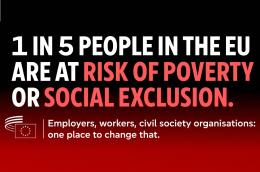
From breaking intergenerational disadvantage and tackling child poverty to ending homelessness and protecting civic space, the European Economic and Social Committee (EESC) is calling for a comprehensive, rights-based approach to poverty. Key opinions adopted during its October plenary underline one central message: lasting solutions must be shaped with the support of civil society and the people most affected.
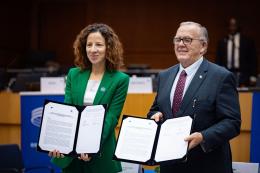
The European Economic and Social Committee (EESC) and the European Commission signed a Memorandum of Understanding to strengthen their cooperation in the fight against poverty and social exclusion. EESC President Séamus Boland, EU policymakers, civil society representatives, social partners and people with lived experience of poverty discussed how Europe can accelerate progress towards eradicating poverty by 2050 at a debate hosted by the EESC.
Poverty is not simply a lack of income. It can mean being unable to afford food, heating, healthcare or secure housing, or to participate fully in society. To mark the International Day for the Eradication of Poverty, the European Economic and Social Committee (EESC) highlights its longstanding call for coordinated European action to tackle its many interconnected causes.
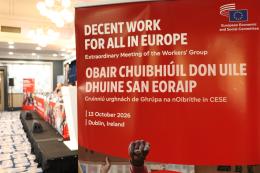
We, at the EESC Workers’ Group, express our full solidarity with the Irish trade unions and the hundreds of thousands of public sector workers, taking industrial action to demand fair pay and decent working conditions. We salute the massive participation from all sectors in what is shaping up to be the biggest day of nationwide industrial action since 2008.
The European Union must ensure that today’s political choices do not lead to further inequalities or leave future generations carrying an unfair share of the costs. This is the central message of an opinion adopted by the European Economic and Social Committee (EESC), which calls for intergenerational fairness to become a measurable principle embedded across all EU policies.
Responsibility for preventing cyberbullying must rest primarily with digital platforms rather than with children and young people. This is the central message of a new opinion in which the European Economic and Social Committee (EESC) calls for stronger platform accountability, straightforward reporting procedures and meaningful youth participation in the fight against harmful online behaviour.