Comhaontú Glas don Eoraip

This page is also available in:

An 11 Nollaig 2019, sheol an Coimisiún Eorpach an Comhaontú Glas don Eoraip lena dtreisítear tiomantas an Aontais dul i ngleic leis na dúshláin a bhaineann leis an aeráid agus leis an gcomhshaol, arb é cúram sainithe na glúine seo é. Is é is cuspóir don Chomhaontú Glas don Eoraip geilleagar nua-aimseartha iomaíoch atá tíosach ar acmhainní a dhéanamh den Aontas, rud lena n-áiritheofar an méid seo a leanas:

  • beifear gan glanastaíochtaí gás ceaptha teasa faoi 2050;
  • geilleagar ina scarfar fás eacnamaíoch ó úsáid acmhainní;
  • geilleagar nach bhfágfar aon duine ná ionad ar lár ann.

Chun an Comhaontú Glas don Eoraip a chur i gcrích, tá pacáiste cuimsitheach tionscnamh á chur i gcrích ag an Aontas, lena n-áirítear tograí beartais agus reachtacha mar aon le forbairt agus nuachóiriú na n-ionstraimí maoiniúcháin.

Bhí sé á iarraidh ag CESE go mbeadh ‘Comhaontú Glas agus Sóisialta’ ann, agus béim á leagan aige ar an dlúthnasc idir an Comhaontú Glas agus ceartas sóisialta. Tá sé ríthábhachtach go n-éistfear le tuairimí na ngeallsealbhóirí uile chun na cuideachtaí inbhuanaithe iomaíocha a bheidh ann amach anseo a chothú i dtimpeallacht shláintiúil.

Leis an gComhaontú Glas don Eoraip, leagadh béim láidir ar infheistíocht agus ar mhaoiniú an aistrithe ghlais agus inbhuanaithe. Is é an Comhaontú Glas a thabharfaidh an Eoraip slán ó phaindéim COVID-19. Is le haon trian de na hinfheistíochtaí ón bPlean Téarnaimh Next Generation EU dar luach 1.8 trilliún euro, agus le buiséad seacht mbliana an Aontais a mhaoinítear an Comhaontú Glas don Eoraip. Tá sé i gceist leis na deiseanna cistiúcháin nua sin leas a bhaint as an ngéarchéim chun todhchaí na hEorpa a mhúnlú.

ról ríthábhachtach ag CESE maidir le faireachán a dhéanamh ar chur chun feidhme thionscnaimh agus ghníomhaíochtaí an Chomhaontaithe Ghlais don Eoraip. Ullmhaíonn CESE tuairimí agus eagraíonn sé gníomhaíochtaí (féach an roghchlár ar thaobh na láimhe clé den leathanach seo) chun a áirithiú go gcuireann institiúidí an Aontais tuairimí na sochaí sibhialta eagraithe san áireamh agus go bhfuil tionscnaimh an Chomhaontaithe Ghlais ag teacht leis na cúinsí eacnamaíocha, sóisialta agus sibhialta ar an láthair.

Mar gheall ar a idirdhisciplíní agus a uilechuimsithí atá sé, cumhdaítear an Comhaontú Glas don Eoraip le rannóga uile CESE agus CCMI.

  • Tuairimí a glacadh on 15/07/2020 - Bureau decision date: 20/02/2020
    Reference
    REX/529-EESC-2020
    (France

    The unprecedented magnitude of the COVID crisis requires an unprecedented, long-term and unequivocal response. International trade is a vital tool to finance recovery ge get out of the crisis. In these efforts, the EU must stay true to its values and ensure the protection of businesses, workers and people, leaving no one behind. Recovery must be based on sustainability, and inclusive and green growth. Green Deal measures are therefore more relevant than ever.

    Download — Tuairim ó CESE: A post COVID-19 emergency: the design of a New Multilateral Matrix (own-initiative opinion)
  • Tuairimí a glacadh on 15/07/2020 - Bureau decision date: 18/02/2020
    Reference
    INT/895-EESC-2020
    (Italy
    Civil Society Organisations - GR III
    Ireland

    The Commission's new Circular Economy Action Plan focuses on sustainable products, less waste, product value chains, and circularity in regions and cities, and the global level.

    Download — Tuairim ó CESE: New Circular Economy Action Plan
  • Tuairimí a glacadh on 15/07/2020 - Bureau decision date: 21/01/2020
    Reference
    NAT/784-EESC-2020-1431
    Civil Society Organisations - GR III
    Netherlands
    (Finland

    This EESC opinion will respond to the European Commission's proposal for a regulation on establishing a European Climate Law and it will look into the role of citizens in driving the transformation towards climate neutrality.

    Download — Tuairim ó CESE: European Climate Law
  • Tuairimí a glacadh on 15/07/2020 - Bureau decision date: 21/01/2020
    Reference
    NAT/785-EESC-2020-01432
    Employers - GR I
    Greece
    Workers - GR II
    Germany

    The opinion will provide guidance on how to build on existing structures like citizens' dialogues and assemblies, social dialogue committees in order to structure and mainstream the dialogue with civil society. It will also make recommendations about how to encourage information sharing and public understanding of climate action; how to create real and virtual spaces for exchange on climate and how to build capacity to facilitate grassroots initiatives, among others.

    Download — Tuairim ó CESE: European Climate Pact (Exploratory opinion)
  • Tuairimí a glacadh on 10/06/2020 - Bureau decision date: 21/01/2020
    Reference
    ECO/504-EESC-2020
    (Italy
    (Czech Republic
    Download — Tuairim ó CESE: Just Transition Fund and amendments to the Common Provisions Regulation
  • Tuairimí a glacadh on 10/06/2020 - Bureau decision date: 21/01/2020
    Reference
    ECO/505-EESC-2020-2020-00463-00-00-TRA
    (Spain
    (Czech Republic

    The coronavirus outbreak will have a deep and negative impact on the achievement of the SDGs and the objectives of the European Green Deal. For this reason, the EESC insists on the need to face this urgent threat as soon as possible and focus our recovery efforts without undue delay on the SDGs and the Green Deal. The Sustainable Europe Investment Plan (SEIP) is the first comprehensive policy measure to fulfil very ambitious targets of carbon neutrality until 2050 in line with the EU Green Deal. While saluting the Green Deal's ambitions, the EESC regrets the lack of consistency with the budgetary allocation within the next Multiannual Financial Framework and also expresses its doubts about the effectiveness of climate mainstreaming in all EU programmes and calls on the Member States to involve civil society organisations in pushing for climate-proof EU spending.

    Download — Tuairim ó CESE: European Green Deal Investment Plan
  • Tuairimí a glacadh on 10/06/2020 - Bureau decision date: 24/09/2019
    Reference
    NAT/778-EESC-2019
    (Croatia
    Employers - GR I
    Greece

    The transition to a low-carbon economy is the EU's goal and obligation and the EU committed itself to implement this transition in a socially just and cost-effective manner. It is thus important to examine all the feasible ways of financing climate neutrality, and possibly find new and innovative financing models in the near future.

    Download — Tuairim ó CESE: Financing the Transition to a Low-Carbon Economy and the Challenges in Financing Climate Change Adaptation (Exploratory opinion at the request of the Croatian presidency)
  • The EU needs a long-term vision that takes greater account of geographic specificities. Sustainable water management and food security must become top priorities, with food security and biodiversity going hand in hand. 

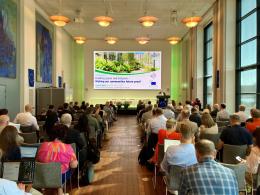
  • On 2 July, the Civil Society Organisations’ Group of the European Economic and Social Committee opened the photo exhibition Giving form to the future at the Danish Society of Engineers (IDA) as part of its conference Building green and inclusive – Making our communities future-proof.

  • Reimagining the design of cities, communities and housing is essential to face the current challenges. Civil society organisations have a key role to play in steering this transformation. Sustainability and the right to housing must be at the heart of future strategies. The EU could contribute to this by increasing European funding for affordable housing and supporting the social economy.