Europäischer Grüner Deal

This page is also available in:

Am 11. Dezember 2019 hat die Europäische Kommission den europäischen Grünen Deal ins Leben gerufen, mit dem das Engagement der EU für die Bewältigung klima- und umweltbezogener Herausforderungen – die entscheidende Aufgabe dieser Generation – gestärkt wird. Ziel des europäischen Grünen Deals ist es, die EU zu einer modernen, ressourceneffizienten und wettbewerbsfähigen Wirtschaft zu machen, die

  • bis 2050 keine Netto-Treibhausgase mehr ausstößt;
  • ihr Wachstum von der Ressourcennutzung abkoppelt;
  • niemanden, weder Mensch noch Region, im Stich lässt.

Zur Umsetzung des europäischen Grünen Deals führt die EU ein umfassendes Paket von Initiativen durch, das politische und legislative Vorschläge sowie die Entwicklung und Modernisierung von Finanzierungsinstrumenten umfasst.

Der EWSA hat sich unter Verweis auf die enge Verbindung zwischen dem Grünen Deal und sozialer Gerechtigkeit für einen „Grünen und sozialen Deal“ eingesetzt. Damit in Zukunft nachhaltige und wettbewerbsfähige Unternehmen in einer gesunden Umwelt florieren können, ist es von entscheidender Bedeutung, darauf zu hören, was alle Interessenträger zu sagen haben.

Ein besonderer Schwerpunkt des er europäischen Grünen Deals liegt auf Investitionen in den grünen und nachhaltigen Wandel und seine Finanzierung. Der Grüne Deal ist das zentrale Mittel zur Überwindung der Folgen der COVID-19-Pandemie. Ein Drittel der 1,8 Billionen Euro aus dem Aufbauplan NextGenerationEU und dem siebenjährigen EU-Haushalt ist für den europäischen Grünen Deal vorgesehen. Diese neuen finanziellen Möglichkeiten sollen die Krise in eine Chance für die Gestaltung der Zukunft Europas umwandeln.

Der EWSA spielt eine entscheidende Rolle bei der Überwachung der Umsetzung der Initiativen und Maßnahmen des europäischen Grünen Deals. Der EWSA erarbeitet Stellungnahmen und organisiert Aktivitäten (siehe die Auswahl links auf dieser Seite), um dafür zu sorgen, dass die EU-Organe die Standpunkte der organisierten Zivilgesellschaft berücksichtigen und die Initiativen des Grünen Deals auf die wirtschaftlichen, sozialen und gesellschaftlichen Gegebenheiten vor Ort abgestimmt sind.

Da der europäische Grüne Deal alle Themenbereiche betrifft, beschäftigen sich sämtliche Fachgruppen des EWSA sowie die CCMI mit ihm.

  • verabschiedet on 15/07/2020 - Bureau decision date: 18/02/2020
    Referenz
    INT/895-EESC-2020
    (Italy
    Civil Society Organisations - GR III
    Ireland

    The Commission's new Circular Economy Action Plan focuses on sustainable products, less waste, product value chains, and circularity in regions and cities, and the global level.

    Download — Stellungnahme des Ausschusses: New Circular Economy Action Plan
  • verabschiedet on 15/07/2020 - Bureau decision date: 21/01/2020
    Referenz
    NAT/785-EESC-2020-01432
    Employers - GR I
    Greece
    Workers - GR II
    Germany

    The opinion will provide guidance on how to build on existing structures like citizens' dialogues and assemblies, social dialogue committees in order to structure and mainstream the dialogue with civil society. It will also make recommendations about how to encourage information sharing and public understanding of climate action; how to create real and virtual spaces for exchange on climate and how to build capacity to facilitate grassroots initiatives, among others.

    Download — Stellungnahme des Ausschusses: European Climate Pact (Exploratory opinion)
  • verabschiedet on 15/07/2020 - Bureau decision date: 21/01/2020
    Referenz
    NAT/784-EESC-2020-1431
    Civil Society Organisations - GR III
    Netherlands
    (Finland

    This EESC opinion will respond to the European Commission's proposal for a regulation on establishing a European Climate Law and it will look into the role of citizens in driving the transformation towards climate neutrality.

    Download — Stellungnahme des Ausschusses: European Climate Law
  • verabschiedet on 10/06/2020 - Bureau decision date: 21/01/2020
    Referenz
    ECO/505-EESC-2020-2020-00463-00-00-TRA
    (Spain
    (Czech Republic

    The coronavirus outbreak will have a deep and negative impact on the achievement of the SDGs and the objectives of the European Green Deal. For this reason, the EESC insists on the need to face this urgent threat as soon as possible and focus our recovery efforts without undue delay on the SDGs and the Green Deal. The Sustainable Europe Investment Plan (SEIP) is the first comprehensive policy measure to fulfil very ambitious targets of carbon neutrality until 2050 in line with the EU Green Deal. While saluting the Green Deal's ambitions, the EESC regrets the lack of consistency with the budgetary allocation within the next Multiannual Financial Framework and also expresses its doubts about the effectiveness of climate mainstreaming in all EU programmes and calls on the Member States to involve civil society organisations in pushing for climate-proof EU spending.

    Download — Stellungnahme des Ausschusses: European Green Deal Investment Plan
  • verabschiedet on 10/06/2020 - Bureau decision date: 21/01/2020
    Referenz
    ECO/504-EESC-2020
    (Italy
    (Czech Republic
    Download — Stellungnahme des Ausschusses: Just Transition Fund and amendments to the Common Provisions Regulation
  • verabschiedet on 10/06/2020 - Bureau decision date: 24/09/2019
    Referenz
    NAT/778-EESC-2019
    (Croatia
    Employers - GR I
    Greece

    The transition to a low-carbon economy is the EU's goal and obligation and the EU committed itself to implement this transition in a socially just and cost-effective manner. It is thus important to examine all the feasible ways of financing climate neutrality, and possibly find new and innovative financing models in the near future.

    Download — Stellungnahme des Ausschusses: Financing the Transition to a Low-Carbon Economy and the Challenges in Financing Climate Change Adaptation (Exploratory opinion at the request of the Croatian presidency)
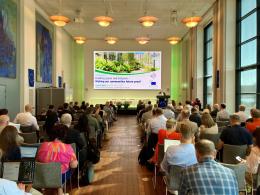
  • On 2 July, the Civil Society Organisations’ Group of the European Economic and Social Committee opened the photo exhibition Giving form to the future at the Danish Society of Engineers (IDA) as part of its conference Building green and inclusive – Making our communities future-proof.

  • Reimagining the design of cities, communities and housing is essential to face the current challenges. Civil society organisations have a key role to play in steering this transformation. Sustainability and the right to housing must be at the heart of future strategies. The EU could contribute to this by increasing European funding for affordable housing and supporting the social economy.

  • Conference of the EESC Civil Society Organisations' Group in the framework of the Danish Presidency of the Council of the European Union, Copenhagen, Danish Society of Engineers (IDA), 2 July 2025

  • Greater use of digitalisation in the construction and housing industry and the involvement of social economy actors in housing provision can bring opportunities to address current challenges in the area of housing affordability and sustainability in Europe. Since housing is not just a need but a human right, a pan-European response to the various challenges is needed, according to a conference organised by the Civil Society Organisations’ Group of the European Economic and Social Committee (EESC) on 21 November, at which a new EESC study on the subject was presented.