European Economic
and Social Committee
European Economic
and Social Committee
The European Economic and Social Committee (EESC) is the voice of organised civil society in Europe.
Find out more about its role and structure at http://www.eesc.europa.eu/en/about
The EESC issues between 160 and 190 opinions, evaluation and information reports a year.
It also organises several annual initiatives and events with a focus on civil society and citizens’ participation such as the Civil Society Prize, the Civil Society Days, the Your Europe, Your Say youth plenary and the ECI Day.
Find the latest EESC opinions and publications at http://www.eesc.europa.eu/en/our-work/opinions-information-reports/opinions and http://www.eesc.europa.eu/en/our-work/publications-other-work/publications respectively.
The EESC is active in a wide range of areas, from social affairs to economy, energy and sustainability.
Learn more about our policy areas and policy highlights at http://www.eesc.europa.eu/en/policies
The EESC holds nine plenary sessions per year. It also organises many conferences, public hearings and high-level debates related to its work.
Find out more about our upcoming events at http://www.eesc.europa.eu/en/agenda/our-events/upcoming-events
Here you can find news and information about the EESC'swork, including its social media accounts, the EESC Info newsletter, photo galleries and videos.
Read the latest EESC news http://www.eesc.europa.eu/en/news-media/news and press releases http://www.eesc.europa.eu/en/news-media/press-releases
The EESC brings together representatives from all areas of organised civil society, who give their independent advice on EU policies and legislation. The EESC's326 Members are organised into three groups: Employers, Workers and Various Interests.
Find out more about our Members and groups at http://www.eesc.europa.eu/en/members-groups
The EESC has six sections, specialising in concrete topics of relevance to the citizens of the European Union, ranging from social to economic affairs, energy, environment, external relations or the internal market.
Find out more at http://www.eesc.europa.eu/en/sections-other-bodies
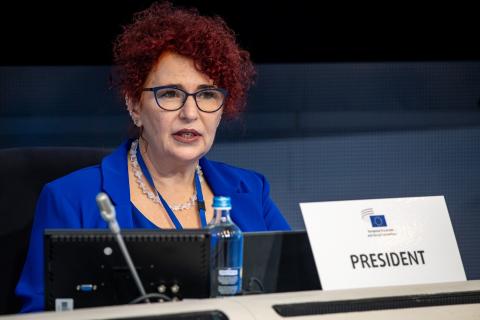
Ekonomiskt välstånd, omsorg om miljön och människors välbefinnande kan och måste gå hand i hand. Detta var EESK-ordförande Christa Schwengs huvudbudskap vid debatten om En ekonomi för tiden efter covid-19 som fungerar för alla – mot en välfärdsekonomi? vid EESK:s plenarsession den 7 juli 2021.
Christa Schweng menade att vi i framtiden tveklöst kommer att behöva övervaka och värdera bredare aspekter än dem som återspeglas i BNP: ”Det som verkligen är viktigt är aspekter som vår hälsa, natur, utbildning och innovationsförmåga samt våra samhällen”, sade hon.
Med hänvisning till ”att kombinera välståndsidén med möjligheten till sociala framsteg på global nivå”, med utgångspunkt i 2030-målen för hållbar utveckling, tillade hon att ”tiden är inne för EU att utarbeta en övergripande strategi: EESK är redo att stödja en reflektion om grunden för en ekonomi för tiden efter covid-19 som fungerar för alla och omfattar nya indikatorer för ekonomiska resultat och sociala framsteg, som kan ge en heltäckande bild av människors välbefinnande”.
Peter Schmidt, ordförande för sektionen för jordbruk, landsbygdsutveckling och miljö (NAT) och föredragande för EESK:s yttrande Den hållbara ekonomi vi behöver, påpekade att en välfärdsekonomi bygger på att tjäna människorna och att EU måste ta vara på den möjlighet som pandemin erbjuder att reflektera över våra svagheter och ta fram förslag. (mp)