We will discuss on the views of the European Parliament, the progress in the Strategy of the Commission, and learn from the presentation of impactful initiatives by a financial sector association and a trade union. A debate with members and remote participants will follow.
Public debate in the ECO Section on the The Multiannual Financial Framework after 2027 - Assessing progress and outstanding challenges. The event will take stock of developments in the negotiations since the Commission presented their proposals for the next Multiannual Financial Framework and discuss outstanding challenges.
This public hearing will aim to examine the growing threat of gender-based cyberviolence against women and girls, including deepfake pornography, non-consensual image sharing and 'nudification' apps. Such abuses are used to intimidate, silence and discredit women in public and professional life. The hearing will explore how to hold perpetrators accountable and identify effective measures to combat online misogyny and protect women’s rights online.
Bulgarian Chamber of Commerce and Industry (9 Iskar Str, Sofia, Bulgaria), and remotely via online platform
Sofia
Bulgaria
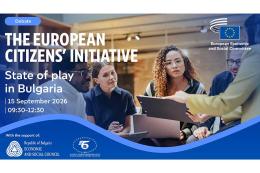
On 15 September 2026, the EESC Group on the European Citizens’ Initiative, with the support of the Economic and Social Council of the Republic of Bulgaria and the Bulgarian Chamber of Commerce and Industry, will organise a debate in Sofia on the state of play of the European Citizens’ Initiative in Bulgaria.
The event will bring together ECI stakeholders and communicators, such as representatives of EU institutions, civil society, youth, academia and local authorities, to discuss how awareness, visibility and participation in the European Citizens’ Initiative can be further strengthened at national level.
Participants will exchange experiences, good practices and ideas on how to make this unique EU participatory democracy tool more accessible and impactful for Bulgarian citizens.
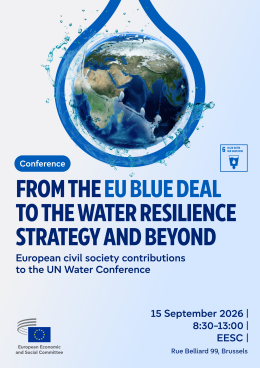
Save the date! On 15 September, the CCMI will organise a high-level event bringing together European civil society and key stakeholders to help shape the EU’s contribution to the UN Water Conference 2026. Building on the EESC’s work on the EU Blue Deal and its recently adopted opinion on this process, the event will foster dialogue and deliver key recommendations from civil society to EU and global decision-makers, feeding into global water policy discussions.
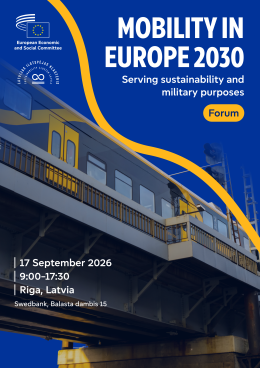
The TEN section, in cooperation with the Latvian Sustainability Cluster, is organising a forum on Mobility in Europe 2030 – serving sustainability and military purposes on 17 September 2026 in Riga, Latvia. The forum will deliver recommendations, identify investment and regulatory priorities, and clarify implementation pathways. The outcome of the forum will feed into the EESC’s policy work at EU level and provide practical guidance for Member States in advancing climate-neutral, resilient and competitive mobility systems, including strengthened military mobility, in response to evolving geopolitical challenges.
The Consultative Commission on Industrial Change (CCMI) of the European Economic and Social Committee will convene an expert hearing to advance policy discussions on fostering innovation and digitalisation in the construction sector.