European Economic
and Social Committee
European Economic
and Social Committee
The European Economic and Social Committee (EESC) is the voice of organised civil society in Europe.
Find out more about its role and structure at http://www.eesc.europa.eu/en/about
The EESC issues between 160 and 190 opinions, evaluation and information reports a year.
It also organises several annual initiatives and events with a focus on civil society and citizens’ participation such as the Civil Society Prize, the Civil Society Days, the Your Europe, Your Say youth plenary and the ECI Day.
Find the latest EESC opinions and publications at http://www.eesc.europa.eu/en/our-work/opinions-information-reports/opinions and http://www.eesc.europa.eu/en/our-work/publications-other-work/publications respectively.
The EESC is active in a wide range of areas, from social affairs to economy, energy and sustainability.
Learn more about our policy areas and policy highlights at http://www.eesc.europa.eu/en/policies
The EESC holds nine plenary sessions per year. It also organises many conferences, public hearings and high-level debates related to its work.
Find out more about our upcoming events at http://www.eesc.europa.eu/en/agenda/our-events/upcoming-events
Here you can find news and information about the EESC'swork, including its social media accounts, the EESC Info newsletter, photo galleries and videos.
Read the latest EESC news http://www.eesc.europa.eu/en/news-media/news and press releases http://www.eesc.europa.eu/en/news-media/press-releases
The EESC brings together representatives from all areas of organised civil society, who give their independent advice on EU policies and legislation. The EESC's326 Members are organised into three groups: Employers, Workers and Various Interests.
Find out more about our Members and groups at http://www.eesc.europa.eu/en/members-groups
The EESC has six sections, specialising in concrete topics of relevance to the citizens of the European Union, ranging from social to economic affairs, energy, environment, external relations or the internal market.
Find out more at http://www.eesc.europa.eu/en/sections-other-bodies
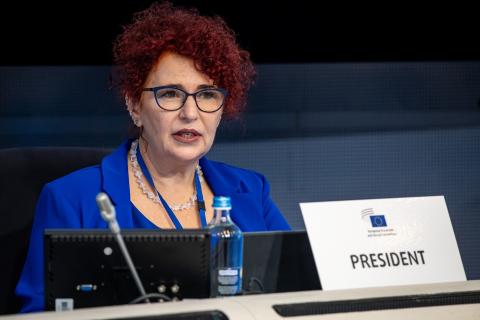
Dobrobyt gospodarczy, troska o środowisko i dobrobyt ludzi mogą i muszą być ze sobą powiązane. Tak brzmiało główne przesłanie przewodniczącej EKES-u Christy Schweng podczas debaty na temat „Gospodarka po pandemii COVID-19 w służbie wszystkich – ku gospodarce dobrobytu?”, która odbyła się na sesji plenarnej Komitetu 7 lipca 2021 r.
Zdaniem Christy Schweng w przyszłości z pewnością niezbędne będzie monitorowanie aspektów wykraczających poza PKB, jak również ich docenianie. „Takie kwestie, jak nasze zdrowie, środowisko, szkolnictwo, zdolność do innowacji czy też nasze społeczności są naprawdę ważne” – powiedziała.
Odnosząc się do „połączenia koncepcji dobrobytu z możliwością społecznego postępu na skalę globalną” na podstawie celów zrównoważonego rozwoju na 2030 r., Christa Schweng dodała: „Nadszedł czas na to, by UE pracowała nad kompleksową strategią – EKES jest gotów wspierać refleksję na temat podstaw gospodarki po pandemii COVID-19, która działa w służbie wszystkich i obejmuje nowe wskaźniki wyników gospodarczych i postępu społecznego ukazujące pełną wizję dobrobytu obywateli”.
Peter Schmidt, przewodniczący Sekcji Rolnictwa, Rozwoju Wsi i Środowiska Naturalnego (NAT) i sprawozdawca opinii EKES-u „Zrównoważona gospodarka, jakiej potrzebujemy”, stwierdził, że gospodarka dobrobytu opiera się na służbie ludziom, a UE musi wykorzystać stworzoną przez pandemię okazję na refleksję nad naszymi słabościami i propozycjami zmian. (mp)