European Economic
and Social Committee
European Economic
and Social Committee
The European Economic and Social Committee (EESC) is the voice of organised civil society in Europe.
Find out more about its role and structure at http://www.eesc.europa.eu/en/about
The EESC issues between 160 and 190 opinions, evaluation and information reports a year.
It also organises several annual initiatives and events with a focus on civil society and citizens’ participation such as the Civil Society Prize, the Civil Society Days, the Your Europe, Your Say youth plenary and the ECI Day.
Find the latest EESC opinions and publications at http://www.eesc.europa.eu/en/our-work/opinions-information-reports/opinions and http://www.eesc.europa.eu/en/our-work/publications-other-work/publications respectively.
The EESC is active in a wide range of areas, from social affairs to economy, energy and sustainability.
Learn more about our policy areas and policy highlights at http://www.eesc.europa.eu/en/policies
The EESC holds nine plenary sessions per year. It also organises many conferences, public hearings and high-level debates related to its work.
Find out more about our upcoming events at http://www.eesc.europa.eu/en/agenda/our-events/upcoming-events
Here you can find news and information about the EESC'swork, including its social media accounts, the EESC Info newsletter, photo galleries and videos.
Read the latest EESC news http://www.eesc.europa.eu/en/news-media/news and press releases http://www.eesc.europa.eu/en/news-media/press-releases
The EESC brings together representatives from all areas of organised civil society, who give their independent advice on EU policies and legislation. The EESC's326 Members are organised into three groups: Employers, Workers and Various Interests.
Find out more about our Members and groups at http://www.eesc.europa.eu/en/members-groups
The EESC has six sections, specialising in concrete topics of relevance to the citizens of the European Union, ranging from social to economic affairs, energy, environment, external relations or the internal market.
Find out more at http://www.eesc.europa.eu/en/sections-other-bodies
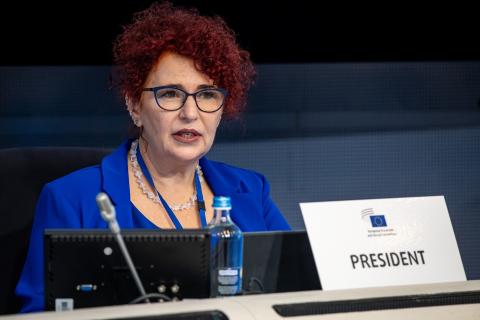
La prosperità economica, il rispetto dell'ambiente e il benessere dei cittadini possono e devono andare di pari passo. Questo è stato il messaggio di fondo della Presidente del CESE Christa Schweng nel suo intervento al dibattito sul tema Un'economia post-COVID al servizio di tutti - Verso un'economia del benessere?, che si è tenuto in occasione della sessione plenaria del CESE del 7 luglio 2021.
Schweng ha affermato che in futuro bisognerà senza dubbio monitorare e valorizzare un ventaglio più ampio di elementi rispetto a quelli presi in considerazione nel PIL: "Anche altri aspetti, quali la salute, l'istruzione, la capacità di innovare e le comunità, svolgono un ruolo rilevante".
Facendo riferimento all'idea di "associare il concetto di prosperità con la possibilità di un progresso sociale su scala mondiale", e prendendo come base gli obiettivi di sviluppo sostenibile da conseguire entro il 2030, Schweng ha aggiunto: "È ora che l'UE lavori ad una strategia globale: il CESE è pronto ad accompagnare la riflessione sui fondamenti di un'economia post-pandemia che funzioni per tutti e che includa nuovi indicatori dei risultati economici e del progresso sociale capaci di delineare un quadro completo del benessere dei cittadini."
In conclusione del dibattito, Peter Schmidt, presidente della sezione Agricoltura, sviluppo rurale, ambiente (NAT) e relatore del parere del CESE sul tema L'economia sostenibile di cui abbiamo bisogno, ha affermato che un'economia del benessere si basa sul servizio alle persone e che l'UE deve cogliere l'opportunità offerta dalla pandemia per riflettere sulle nostre lacune e sui nostri punti deboli e per formulare delle proposte. (mp)