European Economic
and Social Committee
European Economic
and Social Committee
The European Economic and Social Committee (EESC) is the voice of organised civil society in Europe.
Find out more about its role and structure at http://www.eesc.europa.eu/en/about
The EESC issues between 160 and 190 opinions, evaluation and information reports a year.
It also organises several annual initiatives and events with a focus on civil society and citizens’ participation such as the Civil Society Prize, the Civil Society Days, the Your Europe, Your Say youth plenary and the ECI Day.
Find the latest EESC opinions and publications at http://www.eesc.europa.eu/en/our-work/opinions-information-reports/opinions and http://www.eesc.europa.eu/en/our-work/publications-other-work/publications respectively.
The EESC is active in a wide range of areas, from social affairs to economy, energy and sustainability.
Learn more about our policy areas and policy highlights at http://www.eesc.europa.eu/en/policies
The EESC holds nine plenary sessions per year. It also organises many conferences, public hearings and high-level debates related to its work.
Find out more about our upcoming events at http://www.eesc.europa.eu/en/agenda/our-events/upcoming-events
Here you can find news and information about the EESC'swork, including its social media accounts, the EESC Info newsletter, photo galleries and videos.
Read the latest EESC news http://www.eesc.europa.eu/en/news-media/news and press releases http://www.eesc.europa.eu/en/news-media/press-releases
The EESC brings together representatives from all areas of organised civil society, who give their independent advice on EU policies and legislation. The EESC's326 Members are organised into three groups: Employers, Workers and Various Interests.
Find out more about our Members and groups at http://www.eesc.europa.eu/en/members-groups
The EESC has six sections, specialising in concrete topics of relevance to the citizens of the European Union, ranging from social to economic affairs, energy, environment, external relations or the internal market.
Find out more at http://www.eesc.europa.eu/en/sections-other-bodies
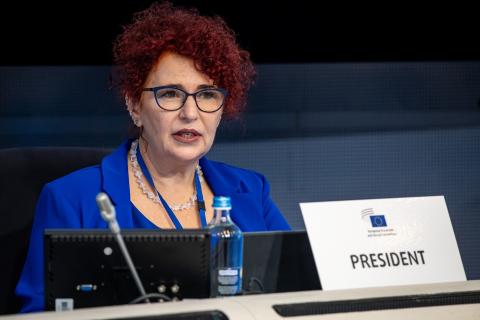
Is féidir leis an rathúnas eacnamaíoch, cúram an chomhshaoil agus folláine daoine a bheith fite fuaite le chéile agus ní mór dóibh a bheith amhlaidh. Ba é sin an phríomhtheachtaireacht a thug Uachtarán Choiste Eacnamaíoch agus Sóisialta na hEorpa (CESE), Christa Schweng, ag an díospóireacht dar teideal Geilleagar iar-COVID a fheidhmíonn do chách – i dtreo gheilleagar na dea-bhaile? a tionóladh ag seisiún iomlánach CESE an 7 Iúil 2021.
D’áitigh Christa Schweng go bhfuil sé soiléir go mbeidh gá sa todhchaí faireachán a dhéanamh ar ghnéithe níos leithne ná na gnéithe a léirítear san olltáirgeacht intíre agus tábhacht a thabhairt do na gnéithe sin : ‘Is gnéithe ríthábhachtacha iad an tsláinte, an nádúr daonna, an t-oideachas, ár gcumas nuálaithe agus ár bpobail’, a dúirt sí.
Agus í ag tagairt do ‘coincheap an rathúnais agus an deis a d’fhéadfadh a bheith ann dul chun cinn sóisialta a dhéanamh ar an leibhéal domhanda a chomhcheangal’ agus Spriocanna Forbartha Inbhuanaithe 2030 a bheith mar bhonn leis an méid sin, luaigh Schweng: ‘Is mithid anois don Aontas dul i mbun obair ar straitéis chuimsitheach: tá CESE réidh chun tacú leis an machnamh atá déanta ar an mbonn a leagfar síos do gheilleagar iar-COVID a fheidhmíonn do chách, lena gcuirtear san áireamh táscairí nua maidir leis an bhfeidhmiú eacnamaíoch agus an dul chun cinn sóisialta lena dtugtar léargas córasach ar fholláine daoine.’
Thug Peter Schmidt,Cathaoirleach na Rannóige um Thalmhaíocht, Forbairt Tuaithe agus an Comhshaol (Rannóg NAT) agus rapóirtéir thuairim CESE dar teidealAn geilleagar Inbhuanaithe atá de dhíth orainn, le fios go bhfuil geilleagar na dea-bhaile bunaithe ar sheirbhísí don duine agus nach mór don Aontas an deis atá curtha ar fáil ag an bpaindéim a thapú chun machnamh a dhéanamh ar a laigí agus tograí nua a dhéanamh. (mp)