European Economic
and Social Committee
European Economic
and Social Committee
The European Economic and Social Committee (EESC) is the voice of organised civil society in Europe.
Find out more about its role and structure at http://www.eesc.europa.eu/en/about
The EESC issues between 160 and 190 opinions, evaluation and information reports a year.
It also organises several annual initiatives and events with a focus on civil society and citizens’ participation such as the Civil Society Prize, the Civil Society Days, the Your Europe, Your Say youth plenary and the ECI Day.
Find the latest EESC opinions and publications at http://www.eesc.europa.eu/en/our-work/opinions-information-reports/opinions and http://www.eesc.europa.eu/en/our-work/publications-other-work/publications respectively.
The EESC is active in a wide range of areas, from social affairs to economy, energy and sustainability.
Learn more about our policy areas and policy highlights at http://www.eesc.europa.eu/en/policies
The EESC holds nine plenary sessions per year. It also organises many conferences, public hearings and high-level debates related to its work.
Find out more about our upcoming events at http://www.eesc.europa.eu/en/agenda/our-events/upcoming-events
Here you can find news and information about the EESC'swork, including its social media accounts, the EESC Info newsletter, photo galleries and videos.
Read the latest EESC news http://www.eesc.europa.eu/en/news-media/news and press releases http://www.eesc.europa.eu/en/news-media/press-releases
The EESC brings together representatives from all areas of organised civil society, who give their independent advice on EU policies and legislation. The EESC's326 Members are organised into three groups: Employers, Workers and Various Interests.
Find out more about our Members and groups at http://www.eesc.europa.eu/en/members-groups
The EESC has six sections, specialising in concrete topics of relevance to the citizens of the European Union, ranging from social to economic affairs, energy, environment, external relations or the internal market.
Find out more at http://www.eesc.europa.eu/en/sections-other-bodies
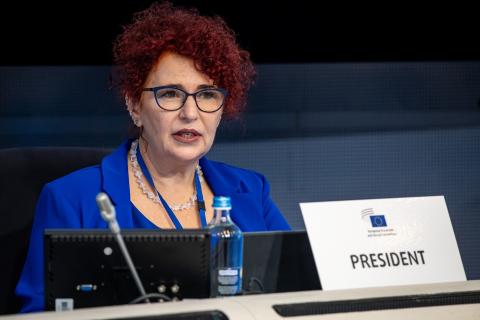
Economische welvaart, zorg voor het milieu en het welzijn van mensen kunnen en moeten hand in hand gaan. Dit was de kernboodschap van EESC-voorzitter Christa Schweng tijdens het debat over Een economie na COVID-19 die voor iedereen werkt – naar een welzijnseconomie? tijdens de EESC-zitting van 7 juli 2021.
Mevrouw Schweng betoogde dat we echt meer moeten gaan kijken naar en waarde moeten gaan hechten aan andere zaken dan het BBP: “Aspecten zoals onze gezondheid, onze natuur, ons onderwijs, ons innovatievermogen en onze gemeenschappen zijn echt belangrijk,” zei ze.
Zij noemde “het combineren van de welvaartsgedachte met de mogelijkheid van sociale vooruitgang op mondiale schaal”, waarbij de duurzameontwikkelingsdoelstellingen voor 2030 als uitgangspunt worden genomen, en voegde daaraan toe: “Het is tijd dat de EU werkt aan een alomvattende strategie: het EESC is bereid steun te verlenen aan de reflectie over de fundamenten voor een economie na COVID-19 die voor iedereen werkt en die nieuwe indicatoren voor economische prestaties en sociale vooruitgang omvat die een volledig beeld van het welzijn van mensen kunnen geven.”
Peter Schmidt, voorzitter van de afdeling Landbouw, Plattelandsontwikkeling en Milieu (NAT) en rapporteur voor het EESC-advies over De duurzame economie die we nodig hebben, wees erop dat een welzijnsgerichte economie gebaseerd is op het dienen van mensen en dat de EU de pandemie moet aangrijpen om over onze zwakke punten na te denken en met voorstellen te komen. (mp)