European Economic
and Social Committee
European Economic
and Social Committee
The European Economic and Social Committee (EESC) is the voice of organised civil society in Europe.
Find out more about its role and structure at http://www.eesc.europa.eu/en/about
The EESC issues between 160 and 190 opinions, evaluation and information reports a year.
It also organises several annual initiatives and events with a focus on civil society and citizens’ participation such as the Civil Society Prize, the Civil Society Days, the Your Europe, Your Say youth plenary and the ECI Day.
Find the latest EESC opinions and publications at http://www.eesc.europa.eu/en/our-work/opinions-information-reports/opinions and http://www.eesc.europa.eu/en/our-work/publications-other-work/publications respectively.
The EESC is active in a wide range of areas, from social affairs to economy, energy and sustainability.
Learn more about our policy areas and policy highlights at http://www.eesc.europa.eu/en/policies
The EESC holds nine plenary sessions per year. It also organises many conferences, public hearings and high-level debates related to its work.
Find out more about our upcoming events at http://www.eesc.europa.eu/en/agenda/our-events/upcoming-events
Here you can find news and information about the EESC'swork, including its social media accounts, the EESC Info newsletter, photo galleries and videos.
Read the latest EESC news http://www.eesc.europa.eu/en/news-media/news and press releases http://www.eesc.europa.eu/en/news-media/press-releases
The EESC brings together representatives from all areas of organised civil society, who give their independent advice on EU policies and legislation. The EESC's326 Members are organised into three groups: Employers, Workers and Various Interests.
Find out more about our Members and groups at http://www.eesc.europa.eu/en/members-groups
The EESC has six sections, specialising in concrete topics of relevance to the citizens of the European Union, ranging from social to economic affairs, energy, environment, external relations or the internal market.
Find out more at http://www.eesc.europa.eu/en/sections-other-bodies
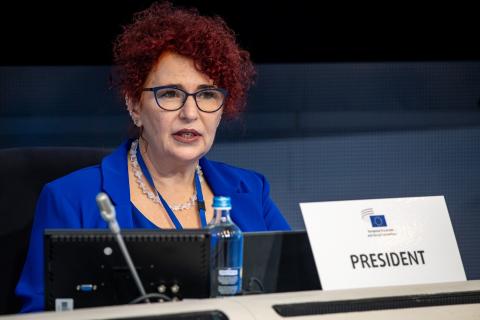
A prosperidade económica, a proteção do ambiente e o bem-estar das pessoas podem e devem andar a par. Esta foi a principal mensagem da presidente do CESE, Christa Schweng, no debate sobre o tema «Uma economia pós-COVID-19 que beneficie todos – Rumo a uma economia do bem-estar?», realizado na reunião plenária do CESE de 7 de julho de 2021.
Christa Schweng afirmou que, no futuro, será claramente necessário acompanhar e avaliar aspetos mais vastos do que os refletidos no PIB: «Aspetos como a nossa saúde, o nosso ambiente, a nossa educação, a nossa capacidade de inovar e as nossas comunidades são realmente importantes.»
Referindo-se à necessidade de «associar a ideia de prosperidade à possibilidade de progresso social a nível mundial», com base nos Objetivos de Desenvolvimento Sustentável para 2030, Christa Schweng acrescentou: «Chegou o momento de a UE trabalhar em prol de uma estratégia abrangente: o CESE está disposto a apoiar a reflexão sobre os alicerces de uma economia pós-COVID-19 que beneficie todos e inclua novos indicadores de desempenho económico e progresso social capazes de dar uma imagem global do bem-estar das pessoas.»
Peter Schmidt, presidente da Secção da Agricultura, Desenvolvimento Rural e Ambiente (NAT) e relator do Parecer do CESE – A economia sustentável de que necessitamos, assinalou que uma economia do bem-estar se baseia no serviço às pessoas e que a UE deve aproveitar a oportunidade proporcionada pela pandemia para refletir sobre os seus pontos fracos e apresentar propostas. (mp)