European Economic
and Social Committee
European Economic
and Social Committee
The European Economic and Social Committee (EESC) is the voice of organised civil society in Europe.
Find out more about its role and structure at http://www.eesc.europa.eu/en/about
The EESC issues between 160 and 190 opinions, evaluation and information reports a year.
It also organises several annual initiatives and events with a focus on civil society and citizens’ participation such as the Civil Society Prize, the Civil Society Days, the Your Europe, Your Say youth plenary and the ECI Day.
Find the latest EESC opinions and publications at http://www.eesc.europa.eu/en/our-work/opinions-information-reports/opinions and http://www.eesc.europa.eu/en/our-work/publications-other-work/publications respectively.
The EESC is active in a wide range of areas, from social affairs to economy, energy and sustainability.
Learn more about our policy areas and policy highlights at http://www.eesc.europa.eu/en/policies
The EESC holds nine plenary sessions per year. It also organises many conferences, public hearings and high-level debates related to its work.
Find out more about our upcoming events at http://www.eesc.europa.eu/en/agenda/our-events/upcoming-events
Here you can find news and information about the EESC'swork, including its social media accounts, the EESC Info newsletter, photo galleries and videos.
Read the latest EESC news http://www.eesc.europa.eu/en/news-media/news and press releases http://www.eesc.europa.eu/en/news-media/press-releases
The EESC brings together representatives from all areas of organised civil society, who give their independent advice on EU policies and legislation. The EESC's326 Members are organised into three groups: Employers, Workers and Various Interests.
Find out more about our Members and groups at http://www.eesc.europa.eu/en/members-groups
The EESC has six sections, specialising in concrete topics of relevance to the citizens of the European Union, ranging from social to economic affairs, energy, environment, external relations or the internal market.
Find out more at http://www.eesc.europa.eu/en/sections-other-bodies
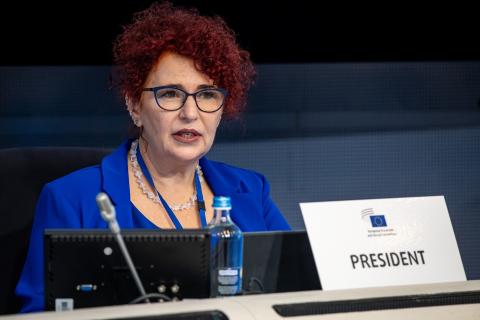
Økonomisk velstand, miljøbeskyttelse og menneskers trivsel kan og skal gå hånd i hånd. Dette var det vigtigste budskab fra EØSU's formand, Christa Schweng, under debatten om En post-covid-økonomi for alle – omstilling til en velfærdsøkonomi? der blev afholdt på EØSU's plenarforsamling den 7. juli 2021.
Christa Schweng argumenterede for, at det i fremtiden uden tvivl bliver nødvendigt at overvåge og værdisætte flere aspekter end dem, der afspejles i BNP: "Aspekter som vores helbred, natur, uddannelse, innovationsevne og lokalsamfund har stor betydning," sagde hun.
Med henvisning til mulighederne for "at kombinere målet om velstand med sociale fremskridt på globalt plan" på grundlag af 2030-målene for bæredygtig udvikling tilføjede Christa Schweng: "Det er på tide, at EU udarbejder en overordnet strategi: EØSU står klar til at støtte overvejelserne om rammevilkårene for en post-covid-økonomi for alle, der inkluderer nye indikatorer for økonomiske resultater og sociale fremskridt, der kan give et overordnet billede af borgernes trivsel."
Peter Schmidt, formand for Sektionen for Landbrug, Udvikling af Landdistrikterne og Miljø (NAT) og ordfører for EØSU's udtalelse om Den bæredygtige økonomi, vi har brug for, påpegede, at en velfærdsøkonomi tjener borgerne, og fremhævede, at EU bør benytte pandemien som en lejlighed til at se nærmere på Unionens svagheder og finde løsninger. (mp)