European Economic
and Social Committee
European Economic
and Social Committee
The European Economic and Social Committee (EESC) is the voice of organised civil society in Europe.
Find out more about its role and structure at http://www.eesc.europa.eu/en/about
The EESC issues between 160 and 190 opinions, evaluation and information reports a year.
It also organises several annual initiatives and events with a focus on civil society and citizens’ participation such as the Civil Society Prize, the Civil Society Days, the Your Europe, Your Say youth plenary and the ECI Day.
Find the latest EESC opinions and publications at http://www.eesc.europa.eu/en/our-work/opinions-information-reports/opinions and http://www.eesc.europa.eu/en/our-work/publications-other-work/publications respectively.
The EESC is active in a wide range of areas, from social affairs to economy, energy and sustainability.
Learn more about our policy areas and policy highlights at http://www.eesc.europa.eu/en/policies
The EESC holds nine plenary sessions per year. It also organises many conferences, public hearings and high-level debates related to its work.
Find out more about our upcoming events at http://www.eesc.europa.eu/en/agenda/our-events/upcoming-events
Here you can find news and information about the EESC'swork, including its social media accounts, the EESC Info newsletter, photo galleries and videos.
Read the latest EESC news http://www.eesc.europa.eu/en/news-media/news and press releases http://www.eesc.europa.eu/en/news-media/press-releases
The EESC brings together representatives from all areas of organised civil society, who give their independent advice on EU policies and legislation. The EESC's326 Members are organised into three groups: Employers, Workers and Various Interests.
Find out more about our Members and groups at http://www.eesc.europa.eu/en/members-groups
The EESC has six sections, specialising in concrete topics of relevance to the citizens of the European Union, ranging from social to economic affairs, energy, environment, external relations or the internal market.
Find out more at http://www.eesc.europa.eu/en/sections-other-bodies
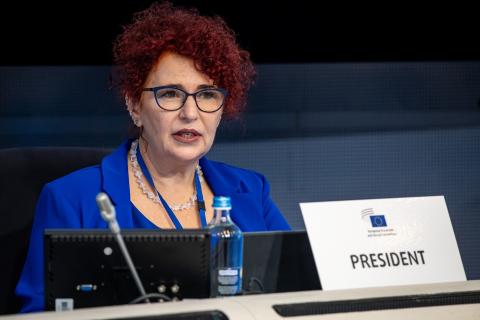
Wirtschaftlicher Wohlstand, Umweltsorge und Wohlergehen der Menschen können und müssen Hand in Hand gehen. So lautete die wichtigste Botschaft von EWSA-Präsidentin Christa Schweng in der Debatte zum Thema „Eine Post-Covid-19-Wirtschaft zum Nutzen aller – Hin zu einer Wirtschaft des Wohlergehens?“ auf der EWSA-Plenartagung am 7. Juli 2021.
Frau Schweng führte aus, dass wir in Zukunft eindeutig umfassendere Aspekte überwachen und bewerten müssen, als sie das BIP widerspiegelt: „Was wirklich wichtig ist, sind Aspekte wie unsere Gesundheit, unsere Natur, unsere Bildung, unsere Innovationsfähigkeit und unsere Gemeinschaften“, sagte sie.
Es gehe darum, „das Konzept des Wohlstands mit der Möglichkeit sozialen Fortschritts auf globaler Ebene zu verbinden“ und dabei von den Nachhaltigkeitszielen der Agenda 2030 als Grundlage auszugehen. „Die EU braucht nun eine umfassende Strategie, und der EWSA ist bereit, sich an den Überlegungen über die Grundlagen für eine Wirtschaft nach der COVID-19-Krise zu beteiligen. Eine Wirtschaft zum Nutzen aller, die neue Indikatoren für die Wirtschaftsleistung und den sozialen Fortschritt einschließt, die ein umfassendes Bild des Wohlergehens der Menschen vermitteln können.“
Abschließend betonte Peter Schmidt, Vorsitzender der Fachgruppe Landwirtschaft, ländliche Entwicklung, Umwelt (NAT) und Berichterstatter für die EWSA-Stellungnahme zum Thema Die nachhaltige Wirtschaft, die wir brauchen, dass eine Ökonomie des Wohlergehens im Dienst der Menschen stehen müsse und dass die EU die Pandemie als Gelegenheit nutzen müsse, um über unsere Schwächen nachzudenken und Vorschläge zu unterbreiten. (mp)