Laienemisprotsessis osalevad riigid

This page is also available in:

Euroopa Majandus- ja Sotsiaalkomitee osaleb aktiivselt ELi laienemisprotsessis ja on töötanud välja paralleelse – piirkondliku ja kahepoolse – lähenemisviisi oma suhete jaoks kodanikuühiskonna organisatsioonidega laienemisprotsessis osalevates riikides.

Seoses piirkondliku lähenemisviisiga on Lääne-Balkani järelevalvekomitee – Euroopa Majandus- ja Sotsiaalkomitee alaline sisene tööorgan – peamine vahend Euroopa Majandus- ja Sotsiaalkomitee tegevuse kooskõlastamiseks selles piirkonnas. Lääne-Balkani kodanikuühiskonna foorum, mida korraldatakse iga kahe aasta järel, on osa järelevalvekomitee tööst.

Euroopa Majandus- ja Sotsiaalkomitee töö Lääne-Balkani riikide ja Türgiga on ka kahepoolne. Et kaasata kodanikuühiskonna organisatsioonid ühinemiseelsesse ja ühinemisprotsessi, on Euroopa Majandus- ja Sotsiaalkomitee loonud riikide ja ELi assotsieerimislepingute alusel kolm ühisorganit kodanikuühiskonna esindajatega – Türgiga, Montenegroga ja Serbiaga. Iga organ koosneb võrdsel arvul liikmetest Euroopa Majandus- ja Sotsiaalkomiteest ja partnerriigist ning koguneb kaks korda aastas.

Selliste laienemisriikide kodanikuühiskonna organisatsioonidega, kellega veel ei ole loodud kodanikuühiskonna esindajate ühisorganit, peab Euroopa Majandus- ja Sotsiaalkomitee korrapärast sidet ja korraldab ühiseid tegevusi.

Ühisorganite tööd täiendab Euroopa Majandus- ja Sotsiaalkomitee arvamuste koostamine konkreetsete riikide ühinemiseelse ja ühinemisprotsessi kohta ning samuti piirkondlikku huvi pakkuvate teemade kohta.

  • In this opinion the EESC:

    • believes that institutionalising civil and social dialogue accelerates the integration of candidate countries into the European social model, based on the representativeness and diversity of the social partners and civil society organisations, and their involvement in public decision-making;
    • notes that National Economic and Social Councils and other forms of institutionalised civil and social dialogue contribute significantly to strengthening the model of governance and participatory democracy. Hence, in states where they do not exist, the establishment of Economic and Social Councils will strengthen the role and place of social partners and civil society organisations in the consultation and partnership relationship with the governments of candidate and partner countries.
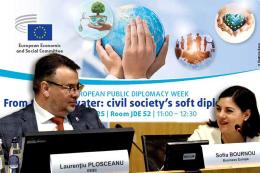
  • On 25 June 2025, the European Economic and Social Committee (EESC) held an event in the context of European Public Diplomacy Week, launched for the first time by the European External Action Service (EEAS). The participants highlighted a fundamental dimension of European action, the contribution of civil society to public diplomacy, from international trade to water, through enlargement. When official diplomacy has limited outreach due to political or other issues, civil society can provide added value.

  • Reference number
    20/2025

    The European Economic and Social Committee (EESC) launched its 10th Western Balkans Civil Society Forum today in Budva, Montenegro, gathering over 100 participants to discuss how to accelerate socio-economic convergence with the EU for improved living standards across the region. The two-day Forum, 13-14 May is taking place in Budva, Montenegro, to support Montenegro's ambition to become the next EU Member State by 2028 and to serve as a model for the rest of the region

  • Reference number
    16/2025

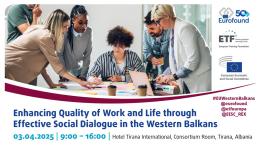
    The European Economic and Social Committee (EESC), the European Training Foundation (ETF), and Eurofound are joining forces on 3 April in Tirana for a high-level event focused on promoting effective social dialogue and collaboration in the Western Balkans. Titled Enhancing quality of work and life through effective social dialogue in the Western Balkans, the by-invitation-only event will bring together key stakeholders to explore challenges and opportunities in the region’s labour markets and social policies.

  • Reference number
    52/2024

    The next Commission must be the enlargement Commission. It is not a question of whether or not to enlarge, but rather how to do it right. This was the focus of the Enlargement High-Level Forum held by the European Economic and Social Committee (EESC) and attended by EESC President Oliver Röpke, European Commissioner for Jobs and Social Rights Nicolas Schmit and ministers from EU Member States and Enlargement candidate countries alike.

  • The EESC:

    • as the first EU body to have involved representatives from candidate countries in its daily work, calls upon the other EU institutions to make the best use of the new accession methodology by involving representatives of the candidate and potential candidate countries in their work;
    • asks the input from the social partners and civil society organisations to be sought in a timely manner for the implementation of the Reform and Growth Facility Plan for the Western Balkans;
    • emphasises the need to address the social dimension of the green transition to an inclusive and just economy and society and calls for EU programmes and regional structures to be bolstered, with the aim of reaching more young people in the Western Balkan;
    • stresses the importance of systematic, meaningful and timely inclusion of the social partners and civil society organisations in the EU accession negotiations, pointing out to the important role of civil society joint consultative committees (JCCs);
    • urges the Commission to address evident attempts to suppress the civic space, and to reflect these issues more prominently in the enlargement strategy and country reports;
  • Reference number
    35/2024

    At its May plenary, the European Economic and Social Committee (EESC) discussed lessons learned from the 2004 EU enlargement. The current geopolitical and security situations make further enlargement an even more urgent task for Europe.

  • Reference number
    31/2024

    20 years after the accession of Slovenia to the EU, the European Economic and Social Committee (EESC) gathered political and civil society leaders in Ljubljana to mark this symbolic anniversary, underlining the fundamental benefits of EU membership and reaffirming that the future of the Western Balkan region lies in the European Union. Speaking at the conference, EESC President Oliver Röpke stressed the EESC's continuous support to the gradual integration of the Western Balkan region in the European Union, announcing the 'Civil Society Enlargement Summit' in Brussels on 19 September. 

  • The EESC has adopted an opinion on the new Reform and Growth Facility for the Western Balkans, at the Commission's request. The plan will support the Western Balkans to speed up regional economic cooperation. This is the first time the EU has focused on economic development and socioeconomic convergence in the region.

  • Reference number
    21/2024

    The 18th meeting of the EU-Montenegro Joint Consultative Committee (JCC), which took place in Podgorica today, sent a clear message to the EU institutions, that Montenegro is firmly committed to becoming the 28th member by 2028. The JCC members encouraged their organisations, the national authorities and the EU institutions to spare no efforts to accomplish the rule of law interim benchmarks. Obtaining the Interim Benchmark Assessment Report (IBAR) for the rule of law by June, will be a turning point in the EU accession process, enabling provisional closing of other chapters.