Države širitve

This page is also available in:

EESO dejavno sodeluje pri procesu širitve EU in je za svoje odnose z organizacijami civilne družbe v državah širitve razvil dvojni pristop, tj. regionalnega in dvostranskega.

Kar zadeva regionalni pristop, je glavni instrument za usklajevanje dejavnosti EESO v regiji spremljevalni odbor za Zahodni Balkan, tj. stalni notranji organ EESO. Del njegove dejavnosti je forum civilne družbe Zahodnega Balkana, organiziran vsaki dve leti.

EESO tudi dvostransko sodeluje z državami Zahodnega Balkana in Turčijo. Na podlagi pridružitvenih sporazumov med temi državami in EU je EESO z namenom, da bi organizacije civilne družbe vključil v predpristopne in pristopne procese, s predstavniki civilne družbe ustanovil tri skupne organe, in sicer s Turčijo, Črno goro in Srbijo. Vsak organ je sestavljen iz enakega števila članov iz EESO in partnerske države ter se sestane dvakrat na leto.

EESO vzdržuje redne stike in organizira skupne dejavnosti z organizacijami civilne družbe v državah širitve, s katerimi še ni bil vzpostavljen noben skupni organ predstavnikov civilne družbe.

EESO delo skupnih organov dopolnjuje s pripravo mnenj o predpristopnih in pristopnih procesih posameznih držav ter o temah v regionalnem interesu.

  • Reference number
    31/2025

    At an Enlargement Forum hosted by the European Economic and Social Committee (EESC), civil society representatives from candidate countries commended the Committee’s Enlargement Candidate Members initiative as a vital tool for shaping their countries’ European integration process and bolstering public support for EU accession. 

  • In this opinion the EESC:

    • believes that institutionalising civil and social dialogue accelerates the integration of candidate countries into the European social model, based on the representativeness and diversity of the social partners and civil society organisations, and their involvement in public decision-making;
    • notes that National Economic and Social Councils and other forms of institutionalised civil and social dialogue contribute significantly to strengthening the model of governance and participatory democracy. Hence, in states where they do not exist, the establishment of Economic and Social Councils will strengthen the role and place of social partners and civil society organisations in the consultation and partnership relationship with the governments of candidate and partner countries.
  • On 25 June 2025, the European Economic and Social Committee (EESC) held an event in the context of European Public Diplomacy Week, launched for the first time by the European External Action Service (EEAS). The participants highlighted a fundamental dimension of European action, the contribution of civil society to public diplomacy, from international trade to water, through enlargement. When official diplomacy has limited outreach due to political or other issues, civil society can provide added value.

  • Reference number
    20/2025

    The European Economic and Social Committee (EESC) launched its 10th Western Balkans Civil Society Forum today in Budva, Montenegro, gathering over 100 participants to discuss how to accelerate socio-economic convergence with the EU for improved living standards across the region. The two-day Forum, 13-14 May is taking place in Budva, Montenegro, to support Montenegro's ambition to become the next EU Member State by 2028 and to serve as a model for the rest of the region

  • Reference number
    16/2025

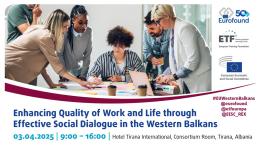
    The European Economic and Social Committee (EESC), the European Training Foundation (ETF), and Eurofound are joining forces on 3 April in Tirana for a high-level event focused on promoting effective social dialogue and collaboration in the Western Balkans. Titled Enhancing quality of work and life through effective social dialogue in the Western Balkans, the by-invitation-only event will bring together key stakeholders to explore challenges and opportunities in the region’s labour markets and social policies.

  • Reference number
    52/2024

    The next Commission must be the enlargement Commission. It is not a question of whether or not to enlarge, but rather how to do it right. This was the focus of the Enlargement High-Level Forum held by the European Economic and Social Committee (EESC) and attended by EESC President Oliver Röpke, European Commissioner for Jobs and Social Rights Nicolas Schmit and ministers from EU Member States and Enlargement candidate countries alike.

  • The EESC:

    • as the first EU body to have involved representatives from candidate countries in its daily work, calls upon the other EU institutions to make the best use of the new accession methodology by involving representatives of the candidate and potential candidate countries in their work;
    • asks the input from the social partners and civil society organisations to be sought in a timely manner for the implementation of the Reform and Growth Facility Plan for the Western Balkans;
    • emphasises the need to address the social dimension of the green transition to an inclusive and just economy and society and calls for EU programmes and regional structures to be bolstered, with the aim of reaching more young people in the Western Balkan;
    • stresses the importance of systematic, meaningful and timely inclusion of the social partners and civil society organisations in the EU accession negotiations, pointing out to the important role of civil society joint consultative committees (JCCs);
    • urges the Commission to address evident attempts to suppress the civic space, and to reflect these issues more prominently in the enlargement strategy and country reports;
  • Reference number
    35/2024

    At its May plenary, the European Economic and Social Committee (EESC) discussed lessons learned from the 2004 EU enlargement. The current geopolitical and security situations make further enlargement an even more urgent task for Europe.

  • Reference number
    31/2024

    Evropski ekonomsko-socialni odbor (EESO) je 20 let po pristopu Slovenije k EU v Ljubljani zbral politične voditelje in voditelje civilne družbe, da bi obeležili to simbolično obletnico in poudarili temeljne prednosti članstva v EU ter ponovno potrdili, da je prihodnost regije Zahodnega Balkana v Evropski uniji. Predsednik EESO Oliver Röpke je na konferenci poudaril, da EESO nenehno podpira postopno vključevanje regije Zahodnega Balkana v Evropsko unijo, in napovedal vrh o širitvi civilne družbe, ki bo 19. septembra v Bruslju. 

  • The EESC has adopted an opinion on the new Reform and Growth Facility for the Western Balkans, at the Commission's request. The plan will support the Western Balkans to speed up regional economic cooperation. This is the first time the EU has focused on economic development and socioeconomic convergence in the region.