Utvidgningsländerna

This page is also available in:

EESK deltar aktivt i EU:s utvidgningsprocess och har utvecklat en tvådelad – regional och bilateral – strategi för förbindelserna med civilsamhällesorganisationer i utvidgningsländerna.

När det gäller den regionala strategin är uppföljningskommittén för västra Balkan – ett permanent internt EESK-organ – det främsta instrumentet för att samordna EESK:s verksamhet i denna region. Forumet för det civila samhället på västra Balkan, som anordnas vartannat år, ingår i uppföljningskommitténs arbete.

EESK samarbetar även bilateralt med länderna på västra Balkan och Turkiet. På grundval av associeringsavtal mellan dessa länder och EU, som syftar till att involvera civilsamhällesorganisationer i föranslutnings- och anslutningsprocesserna, har EESK inrättat tre gemensamma organ med företrädare för det civila samhället – med Turkiet, Montenegro och Serbien. Varje organ består av lika många medlemmar från EESK som från partnerlandet och sammanträder två gånger om året.

EESK har regelbundna kontakter och anordnar gemensamma aktiviteter med civilsamhällesorganisationer i de utvidgningsländer med vilka inget gemensamt organ med företrädare för det civila samhället ännu inrättats.

Arbetet i de gemensamma organen kompletteras med EESK-yttranden om föranslutnings- och anslutningsprocesserna i de enskilda länderna samt om frågor av regionalt intresse.

  • Civil society for an open democratic debate
    Event type
    Conference

    This conference in Lisbon is the fourth event on disinformation being hosted by the European Economic and Social Committee (EESC) as part of its ongoing project aiming to fight disinformation with the help of civil society.

  • Published in
    8 pages

    This resolution presents recommendations of the European Economic and Social Committee to the legislature 2024-2029. They are based on discussions with social partners and civil society organizations from all walks of life, including young people during the first EESC Civil Society Week, and contain a comprehensive set of actionable steps to strengthen and safeguard democratic principles.

  • Reference number
    52/2024

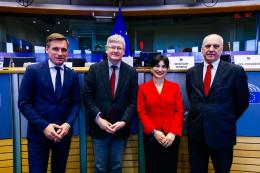
    The next Commission must be the enlargement Commission. It is not a question of whether or not to enlarge, but rather how to do it right. This was the focus of the Enlargement High-Level Forum held by the European Economic and Social Committee (EESC) and attended by EESC President Oliver Röpke, European Commissioner for Jobs and Social Rights Nicolas Schmit and ministers from EU Member States and Enlargement candidate countries alike.

  • Towards a successful EU Enlargment

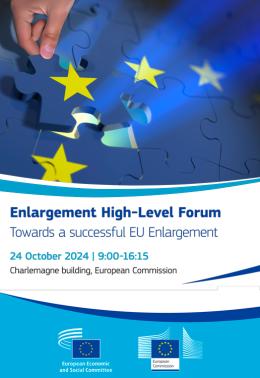
    On 24 th October, the EESC will welcome some 100 Enlargement Candidate Members (ECMs) in the Enlargement High-Level Forum "Towards  successful EU Enlargement" jointly organised with the European Commission back-to-back to Plenary. 

  • The EESC:

    • as the first EU body to have involved representatives from candidate countries in its daily work, calls upon the other EU institutions to make the best use of the new accession methodology by involving representatives of the candidate and potential candidate countries in their work;
    • asks the input from the social partners and civil society organisations to be sought in a timely manner for the implementation of the Reform and Growth Facility Plan for the Western Balkans;
    • emphasises the need to address the social dimension of the green transition to an inclusive and just economy and society and calls for EU programmes and regional structures to be bolstered, with the aim of reaching more young people in the Western Balkan;
    • stresses the importance of systematic, meaningful and timely inclusion of the social partners and civil society organisations in the EU accession negotiations, pointing out to the important role of civil society joint consultative committees (JCCs);
    • urges the Commission to address evident attempts to suppress the civic space, and to reflect these issues more prominently in the enlargement strategy and country reports;
  • Published in
    15 pages

    This document seeks to provide input to the Global Coalition for Social Justice. It highlights key messages from EESC opinions on the six priority areas identified by the International Labour Organization (ILO) for immediate action.

  • Reference number
    35/2024

    At its May plenary, the European Economic and Social Committee (EESC) discussed lessons learned from the 2004 EU enlargement. The current geopolitical and security situations make further enlargement an even more urgent task for Europe.

  • Reference number
    31/2024

    20 years after the accession of Slovenia to the EU, the European Economic and Social Committee (EESC) gathered political and civil society leaders in Ljubljana to mark this symbolic anniversary, underlining the fundamental benefits of EU membership and reaffirming that the future of the Western Balkan region lies in the European Union. Speaking at the conference, EESC President Oliver Röpke stressed the EESC's continuous support to the gradual integration of the Western Balkan region in the European Union, announcing the 'Civil Society Enlargement Summit' in Brussels on 19 September. 

  • Published in
    1 pages

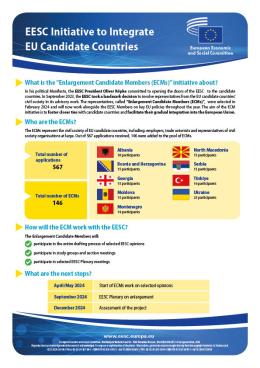
    In his political Manifesto, the EESC President Oliver Röpke committed to opening the doors of the EESC to the candidate countries. In September 2023, the EESC took a landmark decision to involve representatives from the EU candidate countries’ civil society in its advisory work

  • The EESC has adopted an opinion on the new Reform and Growth Facility for the Western Balkans, at the Commission's request. The plan will support the Western Balkans to speed up regional economic cooperation. This is the first time the EU has focused on economic development and socioeconomic convergence in the region.