
European Economic
and Social Committee
Make EU enlargement happen – Our future is also your future
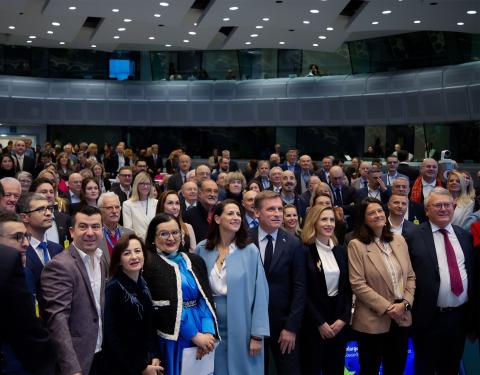
The next Commission must be the enlargement Commission. It is not a question of whether or not to enlarge, but rather how to do it right. This was the focus of the Enlargement High-Level Forum held by the European Economic and Social Committee (EESC) and attended by EESC President Oliver Röpke, European Commissioner for Jobs and Social Rights Nicolas Schmit and ministers from EU Member States and Enlargement candidate countries alike.
The EESC, together with the European Commission, co-organised an Enlargement High-Level Forum, held back-to-back with its October plenary session. More than 140 civil society representatives from enlargement candidate countries converged for the first time ever. The participants’ main point was clear: civil society and social partners, often overlooked in the accession process, must be given a central role in the EU enlargement process.
The enlargement candidate members (ECMs) initiative, which allows civil society in the candidate countries to contribute to the EESC’s work, demonstrates how the active involvement of civil society from candidate countries strengthens the enlargement process. So far, the ECMs have contributed to 12 EESC opinions on subjects related to enlargement, such as EU cohesion policy, the single market, the sustainability of the agri-food sector, and skills shortages.
Mr Röpke stressed: ‘This is not just about expanding the EU – it’s about preparing future Member States to actively participate in shaping the Union, ensuring that they are fully equipped to meet the challenges ahead. Through collaboration with civil society, employers’ federations and trade unions, we are creating the necessary foundation for a more inclusive and stronger Europe. Together, we are reinforcing the values and democratic principles that will bind us as one, addressing shared challenges and seizing common opportunities’.
The debate highlighted the need to keep up the recent momentum surrounding enlargement, as the 2024-2029 Commission will play a crucial role in finalising the enlargement process. In a video message, Olivér Várhelyi, European Commissioner for Neighbourhood and Enlargement, called on the partners involved in the project to keep working towards this common goal so that the next Commission could be an enlargement Commission.
Another key message of the debate was the importance of gradual, predictable and merit-based integration, where progress is recognised and rewarded with real prospects for accession.
Mr Schmit stressed the key role played by civil society, saying: ‘A well-functioning bipartite and tripartite social dialogue and the involvement of social partners are crucial elements in the context of EU accession, as they are part of our social market economy. Economic convergence needs to go hand in hand with upward social convergence based on the principles of the European Pillar of Social Rights and the EU social acquis’.
German Secretary of State Rolf Schmachtenberg said: ‘Labour and social aspects are key for a successful EU accession. Those who want to improve the lives of all citizens, create opportunities and combat social inequalities need effective employment policies, good working conditions and functioning social security systems, with strong social partners. Germany has a strong interest in working closely with future EU Member States on labour and social aspects. For example, my ministry is in contact with colleagues in countries involved in the Berlin process’.
During the debate, Naida Nišić, Montenegrin Minister of Labour, Employment and Social Dialogue, underlined the importance of the high-level forum as a platform for dialogue allowing Montenegro to assess progress. As Minister, Ms Nišić stressed that Montenegro believed that enlargement was about promoting the EU’s core values (democracy, the rule of law and human rights), and not solely about expanding the EU’s borders.
Niki Kerameus, Greek Minister of Labour and Social Security, emphasised: ‘It was a great privilege to participate in this important discussion on EU enlargement and the critical role that social partners play in shaping the future of the European labour and social rights landscape. Especially at a time of multiple crises, this was a valuable opportunity to reflect on how we can collectively contribute to ensuring decent work, fair wages and strong social protections for all, including in candidate countries. Greece stands ready to do its part in providing expertise and technical support needed for ECMs to conform with the EU acquis. We are committed to sharing our own experiences in fostering social dialogue and protecting workers’ rights while implementing labour market reforms’.
Olta Manjani, Albanian Deputy Minister for Economy, Culture and Innovation, said: ‘Albania is actively increasing its presence in EU institutions, committees and working groups, and the establishment of the Joint Consultative Committee with the European Economic and Social Committee is one of these efforts. This involvement is vital for us to gain the knowledge and experience required to better navigate the complexities of EU membership’.
The Enlargement High-Level Forum comprised three sessions. The first, entitled ‘A vibrant civil society as a prerequisite for successful enlargement’, was moderated by Séamus Boland, president of the EESC’s Civil Society Organisations’ Group. The second session, ‘Social dialogue: exchange of good practices and lessons learned – the way forward’, was moderated by Lucie Studničná, president of the EESC’s Workers’ Group; and the third, ‘The role of social partners in fostering competitive green and digital transitions’, was moderated by Stefano Mallia, president of the EESC’s Employers’ Group.
Recording: Enlargement High-Level Forum: Towards a successful EU enlargement
Work organisation
Downloads
-
Make EU enlargement happen – Our future is also your future