Διεθνές εμπόριο

This page is also available in:

International trade is governed by a complex mixture of global rules agreed under World Trade Organization and bilateral and multilateral agreements. The free trade agreements are having a growing impact on citizens' rights. Under the Lisbon Treaty, EU trade policy must be conducted within the framework of the principles and objectives of the Union’s external action, including promotion of the rule of law, human rights and sustainable development.

We believe that this trend should be a guiding principle in EU trade negotiations and in trade relations. The fact that we at the EESC reconcile the positions and views of business, workers, professionals, farmers, consumers and other important stakeholders contributes real added value. We are in a position to efficiently relay the opinions of civil society and interest groups to international policy-makers both during negotiations and in the implementation of trade agreements. We have set up a Follow-up Committee on International trade to ensure that civil society has a say in the shaping of EU trade policy. We are also managing the Domestic Advisory groups set up under the trade and sustainable development chapters of the EU "new generation" trade agreements. These groups, composed of civil society representatives (from inside and outside the EESC) are responsible for identifying trade and sustainable development-related problems in the implementation of a trade agreement.

  • Εγκριθείσα on 26/10/2022 - Bureau decision date: 20/01/2022
    Έγγραφα αναφοράς
    REX/551-EESC-2022
    Workers - GR II
    France
    Download format:
    Download — Γνωμοδότηση της ΕΟΚΕ: Multilateral investor-state arbitration court: assessment of the UNCITRAL process and its achievements in light of civil society recommendations
  • Document type
    Joint declaration
    Latest update

    Statement from EU DAG on the occasion of the 1st meeting of the Viet Nam – European Union Joint Civil Society Dialogue Forum.

    • Statement from EU DAG on the occasion of the 1st meeting of the Viet Nam – European Union Joint Civil Society Dialogue Forum
  • The EU and the Vietnam Domestic Advisory Groups (DAGs), established under the Trade and Sustainable Development (TSD) chapter of the EU-Vietnam Free Trade Agreement met in a so called DAG-to-DAG meeting on 9 November 2021.

  • This preparatory meeting took place ahead of the joint meetings with the Vietnamese counterparts scheduled for the second week of November. It also gave the EU DAG the opportunity to receive an update from DG Trade on the implementation of the FTA as well as a timely update on TSD-related issues and implementation.

  • The EU-Vietnam Free Trade Agreement (FTA) envisages that DAG members of each Party meet together at a Civil Society Forum to conduct a dialogue encompassing sustainable development aspects of trade relations between the Parties.

  • Published in
    8 pages

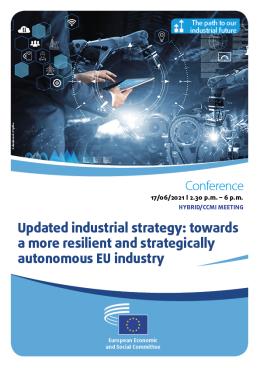
    Following the publication of the European Commission's Update to the New Industrial Strategy, the European Economic and Social Committee (EESC) has been carrying out a series of activities to fulfil its role of representing the views of organised civil society. A key event in this process has been a conference held on 17 June 2021, from 2.30 to 6 p.m., on Updated industrial strategy: towards a more resilient and strategically autonomous EU industry.

  • Published in
    8 pages

    Following the publication of the European Commission's Update to the New Industrial Strategy, the European Economic and Social Committee (EESC) has been carrying out a series of activities to fulfil its role of representing the views of organised civil society. A first event in this process has been a conference held on 17 June 2021, from 2.30 to 6 p.m., on Updated industrial strategy: towards a more resilient and strategically autonomous EU industry?

  • Published in
    Thematic paper
    4 pages

    The European Economic and Social Committee (EESC) and the Consultative Commission on Industrial Change (CCMI) believe that the present and future of critical raw materials resilience is of essential concern to EU's organised civil society. For this reason, and because the Commission's Action Plan represents a step forward by providing a clear roadmap with initiatives and actions to be taken at EU level, overall the EESC recommends that the European Parliament and the Council support this approach. 

  • The 15th meeting of the EU Advisory Group for the EU-Colombia, Peru and Ecuador Free Trade Agreement is held on 29 April 2021 via video-conference.

  • Εγκριθείσα on 20/10/2021 - Bureau decision date: 25/03/2021
    Έγγραφα αναφοράς
    REX/535-EESC-2021
    Workers - GR II
    Germany
    Download format:
    Download — Γνωμοδότηση της ΕΟΚΕ: Next Generation Trade and Sustainable Development – Reviewing the 15-point action plan (own-initiative opinion)