Trádáil idirnáisiúnta

This page is also available in:

Rialaítear an trádáil idirnáisiúnta le sraith chasta de rialacha domhanda arna gcomhaontú faoi chomhaontuithe na hEagraíochta Domhanda Trádála agus faoi chomhaontuithe déthaobhacha agus iltaobhacha. Is ag méadú de réir a chéile atá tionchar na gcomhaontuithe saorthrádála ar chearta na saoránach. Faoi Chonradh Liospóin, ní mór beartas trádála an Aontas Eorpaigh a chur i gcrích faoi chuimsiú phrionsabail agus chuspóirí ghníomhaíocht sheachtrach an Aontais, lena n-áirítear an smacht reachta, cearta an duine agus forbairt inbhuanaithe a chur chun cinn.

Creidimid gur cheart an treocht seo a bheith ina treoirphrionsabal i dtaca le caibidlíocht trádála an Aontais agus le caidreamh trádála. Tá breisluach dháiríre ag baint leis an gcaoi a ndéanann CESE iarracht ar sheasaimh agus tuairimí lucht gnó, oibrithe, gairmithe, feirmeoirí, tomhaltóirí agus geallsealbhóirí tábhachtacha eile a thabhairt le chéile. Táimid in ann tuairimí na sochaí sibhialta agus na ngrúpaí sainleasa a chur in iúl go héifeachtúil do lucht ceaptha beartas idirnáisiúnta le linn caibidlíochta agus le linn cur chun feidhme comhaontuithe trádála. Chuireamar Coiste Leantach um Thrádáil Idirnáisiúnta ar bun chun a chinntiú go mbeadh tionchar ag an tsochaí shibhialta ar fhorbairt bheartas trádála an Aontais Eorpaigh. Ina cheann sin, táimid i mbun na Grúpaí Comhairleacha Baile a bhainistiú, a bunaíodh faoi na caibidlí maidir le trádáil agus forbairt inbhuanaithe atá sa "ghlúin nua" de chomhaontuithe trádála an Aontais Eorpaigh. Is iad na grúpaí sin, atá comhdhéanta d'ionadaithe ón tsochaí shibhialta (ón taobh istigh de CESE agus ón taobh amuigh), atá freagrach as fadhbanna a bhaineann le trádáil agus forbairt inbhuanaithe a aithint nuair a bhíonn comhaontú trádála á chur chun feidhme.
  • Published in
    12 pages

    EESC Employers’ Group priorities 

    This document presents the five priorities of the EESC Employers’ Group and the policy actions for policymakers to improve the business environment, and thereby the EU’s competitiveness and conditions for creating prosperity for citizens.

  • During the 26th meeting, the DAG Members exchanged views with representatives of the EEAS, DG TRADE and DG INTPA on the political, social and economic situation in Colombia, Peru and Ecuador, the implementation of the Trade Agreement and ongoing cooperation initiatives. Discussions also covered labour rights, sustainable development, civil society participation and current Single Entry Point complaints. In its internal session, the DAG discussed preparations for the joint events in Quito, including the regional labour conference, and follow-up to the Joint Declaration approved in Lima in 2025.

  • As global trade governance becomes more fragmented and politicised, members from all 15 EU Domestic Advisory Groups met in Brussels to discuss how organised civil society can strengthen its contribution to the implementation of EU trade agreements and ensure that sustainability commitments are effectively monitored and followed up.

  • -

    Joint events of the Domestic Advisory Groups of the EU and six Central American countries were hosted by the European Unionin Brussels, on 15-16 June 2026.

  • Third meeting of the EU - New Zealand DAG

    The EU-New Zealand Domestic Adivsory Group met for the 3rd time on 11 May to discuss priorities for the EU DAG, and future joint meetings. 

  • The 25th meeting of the EU-Colombia/Peru/Ecuador Domestic Advisory Group held on 20 April 2026 focused on the political, social and labour situation in the Andean region alongside the implementation of the EU trade agreement. Participants highlighted a deteriorating context marked by political instability, security concerns and persistent human rights and labour rights violations, as well as broader issues such as environmental degradation and the impact of drug trafficking.

  • -

    Between 26 and 29 March 2026, EESC members joined the EU delegation at the 14th Ministerial Conference of the World Trade Organisation (WTO) in Yaoundé.

    The delegation attended the daily debriefings for civil society hosted by DG Trade, and had informal meetings with the African Union ECOSOCC, the WTO, the French business association AFEP and the International Trade Union Confederation (ITUC). A short impromptu meeting was also organized with MEP Warborn (INTA).

  • -

    Domestic Advisory Groups of the EU and three Andean countries – Colombia, Peru and Ecuador – held their 11th Joint Meeting and Workshop on 2-3 December 2025 in Lima. The discussions focused on future priorities for cooperation, the role of civil society in monitoring and advancing Trade and Sustainable Development commitments, and key thematic areas such as labour rights, environmental challenges, and EU supply-chain sustainability regulations.

  • Published in
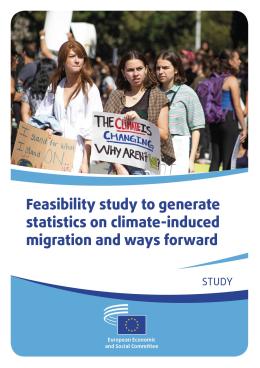
    Study
    72 pages

    This feasibility study to generate statistics on climate-induced migration and ways forward sought to gather and review existing data on climate-induced migration, focussing on five Member States (France, Germany, Greece, Italy and Spain) and one candidate country (Türkiye), to inform an effective EU response. There is no universally agreed definition of climate-induced migration. The majority of population movements as a result of rapid onset events takes place within a country as opposed to across borders.

  • On 25 June 2025, the European Economic and Social Committee (EESC) held an event in the context of European Public Diplomacy Week, launched for the first time by the European External Action Service (EEAS). The participants highlighted a fundamental dimension of European action, the contribution of civil society to public diplomacy, from international trade to water, through enlargement. When official diplomacy has limited outreach due to political or other issues, civil society can provide added value.