Internationaler Handel

This page is also available in:

Im Bereich des internationalen Handels besteht ein komplexes System weltweiter Regelungen, die im Rahmen von Vereinbarungen der Welthandelsorganisation sowie bilateralen und multilateralen Abkommen beschlossen wurden. Die Freihandelsabkommen wirken sich zunehmend auf die Bürgerrechte aus. Gemäß dem Vertrag von Lissabon muss die EU-Handelspolitik unter Berücksichtigung der Grundsätze und Ziele der Außenpolitik der Union gestaltet werden. Hierzu gehören die Förderung der Rechtsstaatlichkeit, der Menschenrechte und der nachhaltigen Entwicklung.

Der EWSA ist der Auffassung, dass dies ein Leitprinzip für die Handelsverhandlungen und ‑beziehungen der EU sein sollte. Er gewährleistet die Konsensbildung von Unternehmen, Arbeitnehmern, Freiberuflern, Landwirten, Verbrauchern und anderen wichtigen Interessenträgern und schafft damit einen echten Mehrwert. Er leitet die Standpunkte der Zivilgesellschaft und Interessengruppen sowohl bei den Verhandlungen über Handelsabkommen als auch bei deren Umsetzung auf effiziente Weise an die internationalen politischen Entscheidungsträger weiter. Er hat einen Begleitausschuss Internationaler Handel eingerichtet, um sicherzustellen, dass die Zivilgesellschaft in die Gestaltung der EU-Handelspolitik einbezogen wird. Zudem leitet er die Internen Beratungsgruppen, die auf Grundlage der Kapitel „Handel und nachhaltige Entwicklung“ in den EU-Handelsabkommen der neuen Generation eingerichtet wurden. Aufgabe dieser Beratungsgruppen, denen Vertreter der Zivilgesellschaft (u. a. aus den Reihen des EWSA) angehören, ist es, Probleme im Bereich Handel und nachhaltige Entwicklung aufzuzeigen, die bei der Umsetzung eines Handelsabkommens auftreten können.

  • verabschiedet on 26/10/2022 - Bureau decision date: 20/01/2022
    Referenz
    REX/551-EESC-2022
    Workers - GR II
    France
    Download format:
    Download — Stellungnahme des Ausschusses: Multilateral investor-state arbitration court: assessment of the UNCITRAL process and its achievements in light of civil society recommendations
  • Document type
    Joint declaration
    Latest update

    Statement from EU DAG on the occasion of the 1st meeting of the Viet Nam – European Union Joint Civil Society Dialogue Forum.

    • Statement from EU DAG on the occasion of the 1st meeting of the Viet Nam – European Union Joint Civil Society Dialogue Forum
  • The EU and the Vietnam Domestic Advisory Groups (DAGs), established under the Trade and Sustainable Development (TSD) chapter of the EU-Vietnam Free Trade Agreement met in a so called DAG-to-DAG meeting on 9 November 2021.

  • This preparatory meeting took place ahead of the joint meetings with the Vietnamese counterparts scheduled for the second week of November. It also gave the EU DAG the opportunity to receive an update from DG Trade on the implementation of the FTA as well as a timely update on TSD-related issues and implementation.

  • The EU-Vietnam Free Trade Agreement (FTA) envisages that DAG members of each Party meet together at a Civil Society Forum to conduct a dialogue encompassing sustainable development aspects of trade relations between the Parties.

  • Published in
    8 pages

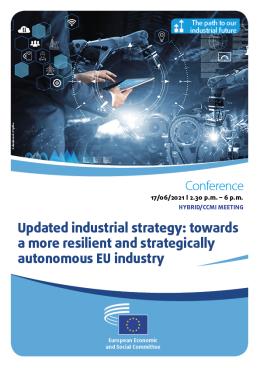
    Following the publication of the European Commission's Update to the New Industrial Strategy, the European Economic and Social Committee (EESC) has been carrying out a series of activities to fulfil its role of representing the views of organised civil society. A key event in this process has been a conference held on 17 June 2021, from 2.30 to 6 p.m., on Updated industrial strategy: towards a more resilient and strategically autonomous EU industry.

  • Published in
    8 pages

    Following the publication of the European Commission's Update to the New Industrial Strategy, the European Economic and Social Committee (EESC) has been carrying out a series of activities to fulfil its role of representing the views of organised civil society. A first event in this process has been a conference held on 17 June 2021, from 2.30 to 6 p.m., on Updated industrial strategy: towards a more resilient and strategically autonomous EU industry?

  • Published in
    Thematic paper
    4 pages

    The European Economic and Social Committee (EESC) and the Consultative Commission on Industrial Change (CCMI) believe that the present and future of critical raw materials resilience is of essential concern to EU's organised civil society. For this reason, and because the Commission's Action Plan represents a step forward by providing a clear roadmap with initiatives and actions to be taken at EU level, overall the EESC recommends that the European Parliament and the Council support this approach. 

  • The 15th meeting of the EU Advisory Group for the EU-Colombia, Peru and Ecuador Free Trade Agreement is held on 29 April 2021 via video-conference.

  • verabschiedet on 20/10/2021 - Bureau decision date: 25/03/2021
    Referenz
    REX/535-EESC-2021
    Workers - GR II
    Germany
    Download format:
    Download — Stellungnahme des Ausschusses: Next Generation Trade and Sustainable Development – Reviewing the 15-point action plan (own-initiative opinion)