European Economic
and Social Committee
European Economic
and Social Committee
The European Economic and Social Committee (EESC) is the voice of organised civil society in Europe.
Find out more about its role and structure at http://www.eesc.europa.eu/en/about
The EESC issues between 160 and 190 opinions, evaluation and information reports a year.
It also organises several annual initiatives and events with a focus on civil society and citizens’ participation such as the Civil Society Prize, the Civil Society Days, the Your Europe, Your Say youth plenary and the ECI Day.
Find the latest EESC opinions and publications at http://www.eesc.europa.eu/en/our-work/opinions-information-reports/opinions and http://www.eesc.europa.eu/en/our-work/publications-other-work/publications respectively.
The EESC is active in a wide range of areas, from social affairs to economy, energy and sustainability.
Learn more about our policy areas and policy highlights at http://www.eesc.europa.eu/en/policies
The EESC holds nine plenary sessions per year. It also organises many conferences, public hearings and high-level debates related to its work.
Find out more about our upcoming events at http://www.eesc.europa.eu/en/agenda/our-events/upcoming-events
Here you can find news and information about the EESC'swork, including its social media accounts, the EESC Info newsletter, photo galleries and videos.
Read the latest EESC news http://www.eesc.europa.eu/en/news-media/news and press releases http://www.eesc.europa.eu/en/news-media/press-releases
The EESC brings together representatives from all areas of organised civil society, who give their independent advice on EU policies and legislation. The EESC's326 Members are organised into three groups: Employers, Workers and Various Interests.
Find out more about our Members and groups at http://www.eesc.europa.eu/en/members-groups
The EESC has six sections, specialising in concrete topics of relevance to the citizens of the European Union, ranging from social to economic affairs, energy, environment, external relations or the internal market.
Find out more at http://www.eesc.europa.eu/en/sections-other-bodies
Στη σύνοδο ολομέλειας του Δεκεμβρίου η ΕΟΚΕ διεξήγαγε συζήτηση σχετικά με την ανασυγκρότηση και την ανθεκτικότητα της ευρωμεσογειακής περιοχής μετά την πανδημία COVID-19, με έμφαση στον ψηφιακό γραμματισμό.
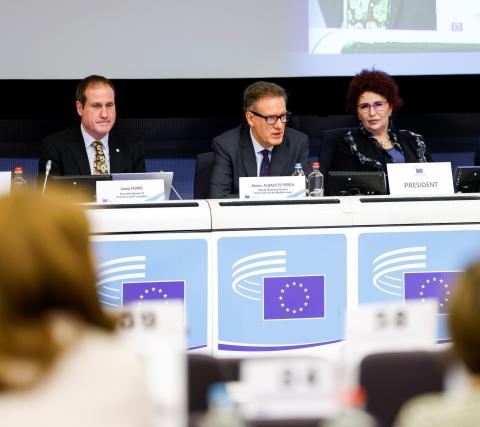
Τονίζοντας τον καίριο ρόλο που διαδραματίζουν η περιφερειακή συνεργασία και ο διάλογος και, ιδίως, το δίκτυο των τοπικών οργανώσεων της κοινωνίας των πολιτών, η Πρόεδρος της ΕΟΚΕ Christa Schweng δήλωσε ότι η Ένωση για τη Μεσόγειο και το Ίδρυμα Anna Lindh αποτελούν πολύ σημαντικούς εταίρους για την ΕΟΚΕ και δύο σημαντικούς πυλώνες της ευρωμεσογειακής εταιρικής σχέσης.
Ο Álvaro Albacete Perea, αναπληρωτής γενικός γραμματέας της Ένωσης για τη Μεσόγειο, και ο Josep Ferré, εκτελεστικός διευθυντής του Ευρωμεσογειακού Ιδρύματος Anna Lindh για τον Διάλογο των Πολιτισμών, τόνισαν την καθοριστική σημασία της ενίσχυσης των σχέσεων μεταξύ της ΕΕ και της περιοχής της Νότιας Μεσογείου.
Η ψηφιοποίηση είναι ζωτικής σημασίας για την οικονομική και κοινωνική πρόοδο σε όλη την ευρωμεσογειακή περιοχή. Στη γνωμοδότηση πρωτοβουλίας με θέμα «Η ψηφιακή μετάβαση στην ευρωμεσογειακή περιοχή» και εισηγήτρια τη Dolores Sammut Bonnici που εγκρίθηκε στη σύνοδο ολομέλειας, επισημαίνεται ότι είναι σημαντικό να μειωθεί το ψηφιακό χάσμα μεταξύ των επιμέρους χωρών, μεταξύ αστικών και αγροτικών περιοχών και μεταξύ γενεών. (mp)