European Economic
and Social Committee
European Economic
and Social Committee
The European Economic and Social Committee (EESC) is the voice of organised civil society in Europe.
Find out more about its role and structure at http://www.eesc.europa.eu/en/about
The EESC issues between 160 and 190 opinions, evaluation and information reports a year.
It also organises several annual initiatives and events with a focus on civil society and citizens’ participation such as the Civil Society Prize, the Civil Society Days, the Your Europe, Your Say youth plenary and the ECI Day.
Find the latest EESC opinions and publications at http://www.eesc.europa.eu/en/our-work/opinions-information-reports/opinions and http://www.eesc.europa.eu/en/our-work/publications-other-work/publications respectively.
The EESC is active in a wide range of areas, from social affairs to economy, energy and sustainability.
Learn more about our policy areas and policy highlights at http://www.eesc.europa.eu/en/policies
The EESC holds nine plenary sessions per year. It also organises many conferences, public hearings and high-level debates related to its work.
Find out more about our upcoming events at http://www.eesc.europa.eu/en/agenda/our-events/upcoming-events
Here you can find news and information about the EESC'swork, including its social media accounts, the EESC Info newsletter, photo galleries and videos.
Read the latest EESC news http://www.eesc.europa.eu/en/news-media/news and press releases http://www.eesc.europa.eu/en/news-media/press-releases
The EESC brings together representatives from all areas of organised civil society, who give their independent advice on EU policies and legislation. The EESC's326 Members are organised into three groups: Employers, Workers and Various Interests.
Find out more about our Members and groups at http://www.eesc.europa.eu/en/members-groups
The EESC has six sections, specialising in concrete topics of relevance to the citizens of the European Union, ranging from social to economic affairs, energy, environment, external relations or the internal market.
Find out more at http://www.eesc.europa.eu/en/sections-other-bodies
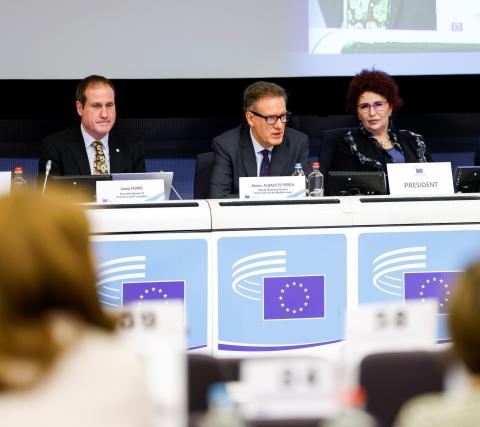
Lors de sa session plénière de décembre, le CESE a tenu un débat sur la reconstruction et la résilience de la région euro-méditerranéenne à la suite de la pandémie de COVID-19, en mettant l’accent sur les aptitudes numériques.
Soulignant le rôle clé joué par la coopération et le dialogue régionaux, et notamment par le réseau des organisations de la société civile actives à l’échelon local, la présidente du Comité, Christa Schweng, a déclaré que l’Union pour la Méditerranée et la Fondation Anna Lindh étaient des partenaires très importants pour le CESE et deux piliers majeurs du partenariat euro-méditerranéen.
Álvaro Albacete Perea, secrétaire général adjoint de l’Union pour la Méditerranée, et Josep Ferré, directeur exécutif de la Fondation euro-méditerranéenne Anna Lindh pour le dialogue entre les cultures, ont évoqué l’importance de renforcer les relations entre l’UE et la région du sud de la Méditerranée.
La numérisation est essentielle au progrès économique et social dans l’ensemble de la région euro-méditerranéenne. L’avis d’initiative sur la «Transition numérique dans la région euro-méditerranéenne», élaboré par Dolores Sammut Bonnici et adopté en session plénière, souligne qu’il est important de réduire la fracture numérique entre les différents pays, entre les zones urbaines et rurales et entre les générations. (mp)