European Economic
and Social Committee
European Economic
and Social Committee
The European Economic and Social Committee (EESC) is the voice of organised civil society in Europe.
Find out more about its role and structure at http://www.eesc.europa.eu/en/about
The EESC issues between 160 and 190 opinions, evaluation and information reports a year.
It also organises several annual initiatives and events with a focus on civil society and citizens’ participation such as the Civil Society Prize, the Civil Society Days, the Your Europe, Your Say youth plenary and the ECI Day.
Find the latest EESC opinions and publications at http://www.eesc.europa.eu/en/our-work/opinions-information-reports/opinions and http://www.eesc.europa.eu/en/our-work/publications-other-work/publications respectively.
The EESC is active in a wide range of areas, from social affairs to economy, energy and sustainability.
Learn more about our policy areas and policy highlights at http://www.eesc.europa.eu/en/policies
The EESC holds nine plenary sessions per year. It also organises many conferences, public hearings and high-level debates related to its work.
Find out more about our upcoming events at http://www.eesc.europa.eu/en/agenda/our-events/upcoming-events
Here you can find news and information about the EESC'swork, including its social media accounts, the EESC Info newsletter, photo galleries and videos.
Read the latest EESC news http://www.eesc.europa.eu/en/news-media/news and press releases http://www.eesc.europa.eu/en/news-media/press-releases
The EESC brings together representatives from all areas of organised civil society, who give their independent advice on EU policies and legislation. The EESC's326 Members are organised into three groups: Employers, Workers and Various Interests.
Find out more about our Members and groups at http://www.eesc.europa.eu/en/members-groups
The EESC has six sections, specialising in concrete topics of relevance to the citizens of the European Union, ranging from social to economic affairs, energy, environment, external relations or the internal market.
Find out more at http://www.eesc.europa.eu/en/sections-other-bodies
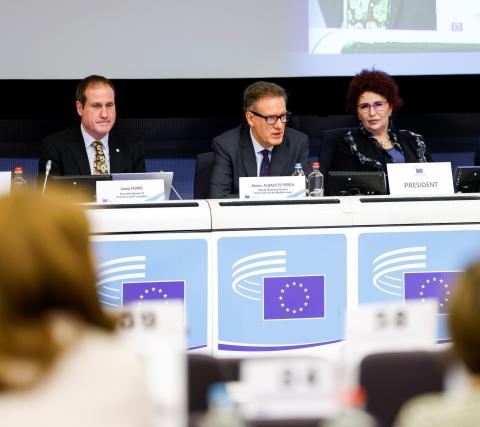
На декемврийската пленарна сесия на ЕИСК беше проведен дебат относно възстановяването и устойчивостта на Евро-средиземноморския регион след пандемията от COVID-19 с акцент върху цифровата грамотност.
Като подчерта ключовата роля на регионалното сътрудничество и диалог, и по-специално на мрежата от местни организации на гражданското общество, председателката на Комитета Криста Швенг заяви, че Съюзът за Средиземноморието и фондацията „Анна Линд“ са много важни партньори за ЕИСК и два основни стълба на евро-средиземноморското партньорство.
Алваро Албасете Переа, заместник генерален секретар на Съюза за Средиземноморието, и Жозеп Фере, изпълнителен директор на Евро-Средиземноморската фондация „Анна Линд“ за евро-средиземноморското партньорство, подчертаха ключовото значение на укрепването на връзките между ЕС и южната част на средиземноморския регион.
Цифровизацията е от основно значение за икономическия и социалния напредък в евро-средиземноморския регион. В становището по собствена инициатива относно „Цифров преход в Евро-средиземноморския регион“, изготвено от Долорес Самут Боничи и прието на пленарната сесия, се посочва, че е важно да се намали цифровото разделение между отделните държави, между градските и селските райони и между поколенията. (mp)