European Economic
and Social Committee
European Economic
and Social Committee
The European Economic and Social Committee (EESC) is the voice of organised civil society in Europe.
Find out more about its role and structure at http://www.eesc.europa.eu/en/about
The EESC issues between 160 and 190 opinions, evaluation and information reports a year.
It also organises several annual initiatives and events with a focus on civil society and citizens’ participation such as the Civil Society Prize, the Civil Society Days, the Your Europe, Your Say youth plenary and the ECI Day.
Find the latest EESC opinions and publications at http://www.eesc.europa.eu/en/our-work/opinions-information-reports/opinions and http://www.eesc.europa.eu/en/our-work/publications-other-work/publications respectively.
The EESC is active in a wide range of areas, from social affairs to economy, energy and sustainability.
Learn more about our policy areas and policy highlights at http://www.eesc.europa.eu/en/policies
The EESC holds nine plenary sessions per year. It also organises many conferences, public hearings and high-level debates related to its work.
Find out more about our upcoming events at http://www.eesc.europa.eu/en/agenda/our-events/upcoming-events
Here you can find news and information about the EESC'swork, including its social media accounts, the EESC Info newsletter, photo galleries and videos.
Read the latest EESC news http://www.eesc.europa.eu/en/news-media/news and press releases http://www.eesc.europa.eu/en/news-media/press-releases
The EESC brings together representatives from all areas of organised civil society, who give their independent advice on EU policies and legislation. The EESC's326 Members are organised into three groups: Employers, Workers and Various Interests.
Find out more about our Members and groups at http://www.eesc.europa.eu/en/members-groups
The EESC has six sections, specialising in concrete topics of relevance to the citizens of the European Union, ranging from social to economic affairs, energy, environment, external relations or the internal market.
Find out more at http://www.eesc.europa.eu/en/sections-other-bodies
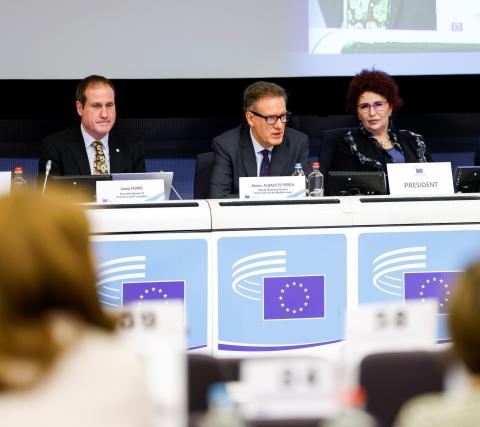
ETSK:n joulukuun täysistunnossa keskusteltiin Euro–Välimeri-alueen jälleenrakentamisesta ja selviytymiskyvystä koronapandemian jälkeen keskittyen digitaaliseen lukutaitoon.
Komitean puheenjohtaja Christa Schweng korosti erityisesti alueellisen yhteistyön ja vuoropuhelun sekä paikallistasolla toimivien kansalaisyhteiskunnan organisaatioiden verkoston keskeistä roolia ja mainitsi Välimeren unionin ja Anna Lindh -säätiön olevan erittäin tärkeitä kumppaneita ETSK:lle ja muodostavan Euro–Välimeri-kumppanuuden kaksi keskeistä pilaria.
Välimeren unionin varapääsihteeri Álvaro Albacete Perea ja kulttuurien välistä vuoropuhelua edistävän Anna Lindhin Euro–Välimeri-säätiön puheenjohtaja Josep Ferré painottivat, miten tärkeää on vahvistaa EU:n ja eteläisen Välimeren alueen suhteita.
Avain taloudelliseen ja sosiaaliseen edistykseen koko Euro–Välimeri-alueella on digitalisaatio. Täysistunnossa hyväksytyssä oma-aloitteisessa lausunnossa Digitalisaatio Euro–Välimeri-alueella, jonka esittelijä on Dolores Sammut Bonnici, todetaankin, että on tärkeää kaventaa yksittäisten maiden, kaupunki- ja maaseutualueiden sekä sukupolvien välistä digitaalista kuilua. (mp)