European Economic
and Social Committee
European Economic
and Social Committee
The European Economic and Social Committee (EESC) is the voice of organised civil society in Europe.
Find out more about its role and structure at http://www.eesc.europa.eu/en/about
The EESC issues between 160 and 190 opinions, evaluation and information reports a year.
It also organises several annual initiatives and events with a focus on civil society and citizens’ participation such as the Civil Society Prize, the Civil Society Days, the Your Europe, Your Say youth plenary and the ECI Day.
Find the latest EESC opinions and publications at http://www.eesc.europa.eu/en/our-work/opinions-information-reports/opinions and http://www.eesc.europa.eu/en/our-work/publications-other-work/publications respectively.
The EESC is active in a wide range of areas, from social affairs to economy, energy and sustainability.
Learn more about our policy areas and policy highlights at http://www.eesc.europa.eu/en/policies
The EESC holds nine plenary sessions per year. It also organises many conferences, public hearings and high-level debates related to its work.
Find out more about our upcoming events at http://www.eesc.europa.eu/en/agenda/our-events/upcoming-events
Here you can find news and information about the EESC'swork, including its social media accounts, the EESC Info newsletter, photo galleries and videos.
Read the latest EESC news http://www.eesc.europa.eu/en/news-media/news and press releases http://www.eesc.europa.eu/en/news-media/press-releases
The EESC brings together representatives from all areas of organised civil society, who give their independent advice on EU policies and legislation. The EESC's326 Members are organised into three groups: Employers, Workers and Various Interests.
Find out more about our Members and groups at http://www.eesc.europa.eu/en/members-groups
The EESC has six sections, specialising in concrete topics of relevance to the citizens of the European Union, ranging from social to economic affairs, energy, environment, external relations or the internal market.
Find out more at http://www.eesc.europa.eu/en/sections-other-bodies
Auf seiner Dezember-Plenartagung debattierte der EWSA über den Wiederaufbau und die Resilienz des Europa-Mittelmeer-Raums nach der COVID-19-Pandemie unter besonderer Berücksichtigung der digitalen Kompetenz.
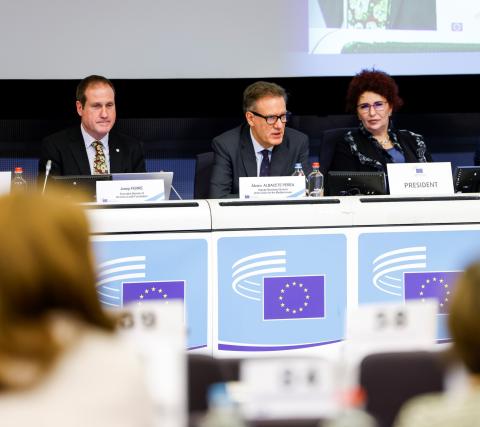
EWSA-Präsidentin Christa Schweng verwies auf die große Bedeutung der regionalen Kooperation und des Dialogs und insbesondere auf die wichtige Rolle des Geflechts lokaler Organisationen der Zivilgesellschaft. Sie bezeichnete die Union für den Mittelmeerraum und die Anna-Lindh-Stiftung als sehr wichtige Partner des EWSA und als zwei tragende Säulen der Partnerschaft Europa-Mittelmeer.
Álvaro Albacete Perea, stellvertretender Generalsekretär der Union für den Mittelmeerraum, und Josep Ferré, Geschäftsführer der Anna-Lindh-Stiftung für den interkulturellen Dialog im Mittelmeerraum, betonten die Wichtigkeit stärkerer Beziehungen zwischen der EU und den Ländern im südlichen Mittelmeerraum.
Die Digitalisierung ist der Schlüssel zum wirtschaftlichen und gesellschaftlichen Fortschritt in der Region Europa-Mittelmeer. Die zentrale Botschaft der von Dolores Sammut Bonnici erarbeiteten und auf der Plenartagung verabschiedeten Initiativstellungnahme zum Digitalen Wandel im Europa-Mittelmeer-Raum ist, dass die digitale Kluft zwischen einzelnen Ländern, zwischen städtischen und ländlichen Gebieten und zwischen den Generationen überwunden werden muss. (mp)