European Economic
and Social Committee
European Economic
and Social Committee
The European Economic and Social Committee (EESC) is the voice of organised civil society in Europe.
Find out more about its role and structure at http://www.eesc.europa.eu/en/about
The EESC issues between 160 and 190 opinions, evaluation and information reports a year.
It also organises several annual initiatives and events with a focus on civil society and citizens’ participation such as the Civil Society Prize, the Civil Society Days, the Your Europe, Your Say youth plenary and the ECI Day.
Find the latest EESC opinions and publications at http://www.eesc.europa.eu/en/our-work/opinions-information-reports/opinions and http://www.eesc.europa.eu/en/our-work/publications-other-work/publications respectively.
The EESC is active in a wide range of areas, from social affairs to economy, energy and sustainability.
Learn more about our policy areas and policy highlights at http://www.eesc.europa.eu/en/policies
The EESC holds nine plenary sessions per year. It also organises many conferences, public hearings and high-level debates related to its work.
Find out more about our upcoming events at http://www.eesc.europa.eu/en/agenda/our-events/upcoming-events
Here you can find news and information about the EESC'swork, including its social media accounts, the EESC Info newsletter, photo galleries and videos.
Read the latest EESC news http://www.eesc.europa.eu/en/news-media/news and press releases http://www.eesc.europa.eu/en/news-media/press-releases
The EESC brings together representatives from all areas of organised civil society, who give their independent advice on EU policies and legislation. The EESC's326 Members are organised into three groups: Employers, Workers and Various Interests.
Find out more about our Members and groups at http://www.eesc.europa.eu/en/members-groups
The EESC has six sections, specialising in concrete topics of relevance to the citizens of the European Union, ranging from social to economic affairs, energy, environment, external relations or the internal market.
Find out more at http://www.eesc.europa.eu/en/sections-other-bodies
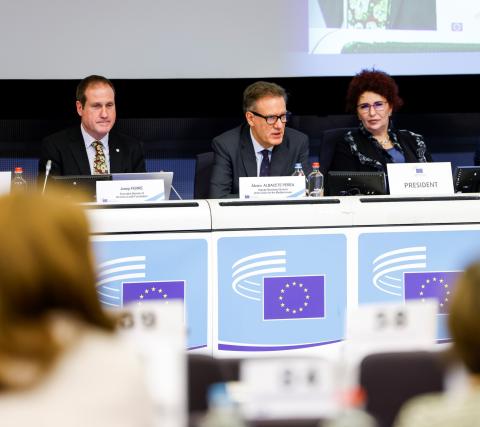
En su pleno de diciembre el CESE celebró un debate sobre la reconstrucción y la resiliencia de la región euromediterránea tras la pandemia de COVID‑19 centrado en la cultura digital.
Christa Schweng, presidenta del CESE, al poner de relieve el papel fundamental que desempeñan la cooperación y el diálogo regionales, en general, y la creación de redes de organizaciones de la sociedad civil, en particular, declaró que la Unión por el Mediterráneo y la Fundación Anna Lindh son socios muy importantes para el CESE y los pilares fundamentales de la colaboración euromediterránea.
Álvaro Albacete Perea, secretario general adjunto de la Unión por el Mediterráneo, y Josep Ferré, director ejecutivo de la Fundación Euromediterránea Anna Lindh para el Diálogo de las Culturas, destacaron la importancia fundamental de reforzar las relaciones entre la UE y la región del Mediterráneo meridional.
La digitalización resulta fundamental para el progreso económico y social en la región euromediterránea. El Dictamen de iniciativa sobre el tema «Transición digital en la región euromediterránea», elaborado por Dolores Sammut Bonnici y aprobado en el pleno, señala la importancia de reducir la brecha digital entre los distintos países, las zonas urbanas y rurales y las generaciones. (mp)