European Economic
and Social Committee
European Economic
and Social Committee
The European Economic and Social Committee (EESC) is the voice of organised civil society in Europe.
Find out more about its role and structure at http://www.eesc.europa.eu/en/about
The EESC issues between 160 and 190 opinions, evaluation and information reports a year.
It also organises several annual initiatives and events with a focus on civil society and citizens’ participation such as the Civil Society Prize, the Civil Society Days, the Your Europe, Your Say youth plenary and the ECI Day.
Find the latest EESC opinions and publications at http://www.eesc.europa.eu/en/our-work/opinions-information-reports/opinions and http://www.eesc.europa.eu/en/our-work/publications-other-work/publications respectively.
The EESC is active in a wide range of areas, from social affairs to economy, energy and sustainability.
Learn more about our policy areas and policy highlights at http://www.eesc.europa.eu/en/policies
The EESC holds nine plenary sessions per year. It also organises many conferences, public hearings and high-level debates related to its work.
Find out more about our upcoming events at http://www.eesc.europa.eu/en/agenda/our-events/upcoming-events
Here you can find news and information about the EESC'swork, including its social media accounts, the EESC Info newsletter, photo galleries and videos.
Read the latest EESC news http://www.eesc.europa.eu/en/news-media/news and press releases http://www.eesc.europa.eu/en/news-media/press-releases
The EESC brings together representatives from all areas of organised civil society, who give their independent advice on EU policies and legislation. The EESC's326 Members are organised into three groups: Employers, Workers and Various Interests.
Find out more about our Members and groups at http://www.eesc.europa.eu/en/members-groups
The EESC has six sections, specialising in concrete topics of relevance to the citizens of the European Union, ranging from social to economic affairs, energy, environment, external relations or the internal market.
Find out more at http://www.eesc.europa.eu/en/sections-other-bodies
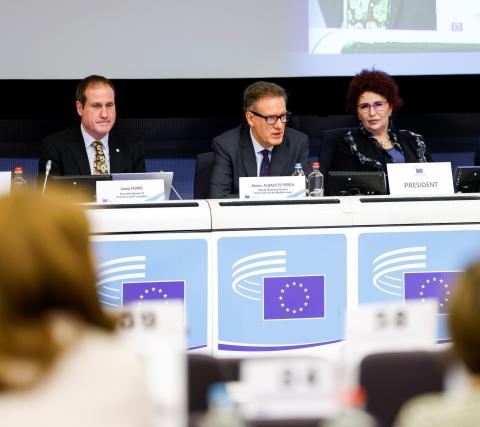
Nella sessione plenaria di dicembre il CESE ha tenuto un dibattito sulla ricostruzione e la resilienza della regione euromediterranea in seguito alla pandemia di COVID-19, con particolare attenzione all'alfabetizzazione digitale.
Sottolineando il ruolo chiave svolto dalla cooperazione e dal dialogo regionali e, in particolare, dalla rete delle organizzazioni della società civile locali, la Presidente del Comitato Christa Schweng ha affermato che l'Unione per il Mediterraneo (UpM) e la Fondazione Anna Lindh sono partner molto importanti per il CESE e due pilastri fondamentali del partenariato euromediterraneo.
Álvaro Albacete Perea, vicesegretario generale dell'UpM, e Josep Ferré, direttore esecutivo della Fondazione euromediterranea Anna Lindh per il dialogo tra culture, hanno posto l'accento sull'importanza cruciale di rafforzare i rapporti tra l'UE e la regione del Mediterraneo meridionale.
Si è inoltre ricordato come la digitalizzazione assuma un rilievo fondamentale per il progresso economico e sociale in tutta la regione euromediterranea. Al riguardo il parere d'iniziativa del CESE sul tema Transizione digitale nella regione euromediterranea, elaborato da Dolores Sammut Bonnici e adottato nel corso della sessione plenaria, mette l'accento sull'importanza di ridurre il divario digitale tra gli Stati membri, tra le zone urbane e quelle rurali e tra i cittadini di generazioni diverse. (mp)