European Economic
and Social Committee
European Economic
and Social Committee
The European Economic and Social Committee (EESC) is the voice of organised civil society in Europe.
Find out more about its role and structure at http://www.eesc.europa.eu/en/about
The EESC issues between 160 and 190 opinions, evaluation and information reports a year.
It also organises several annual initiatives and events with a focus on civil society and citizens’ participation such as the Civil Society Prize, the Civil Society Days, the Your Europe, Your Say youth plenary and the ECI Day.
Find the latest EESC opinions and publications at http://www.eesc.europa.eu/en/our-work/opinions-information-reports/opinions and http://www.eesc.europa.eu/en/our-work/publications-other-work/publications respectively.
The EESC is active in a wide range of areas, from social affairs to economy, energy and sustainability.
Learn more about our policy areas and policy highlights at http://www.eesc.europa.eu/en/policies
The EESC holds nine plenary sessions per year. It also organises many conferences, public hearings and high-level debates related to its work.
Find out more about our upcoming events at http://www.eesc.europa.eu/en/agenda/our-events/upcoming-events
Here you can find news and information about the EESC'swork, including its social media accounts, the EESC Info newsletter, photo galleries and videos.
Read the latest EESC news http://www.eesc.europa.eu/en/news-media/news and press releases http://www.eesc.europa.eu/en/news-media/press-releases
The EESC brings together representatives from all areas of organised civil society, who give their independent advice on EU policies and legislation. The EESC's326 Members are organised into three groups: Employers, Workers and Various Interests.
Find out more about our Members and groups at http://www.eesc.europa.eu/en/members-groups
The EESC has six sections, specialising in concrete topics of relevance to the citizens of the European Union, ranging from social to economic affairs, energy, environment, external relations or the internal market.
Find out more at http://www.eesc.europa.eu/en/sections-other-bodies
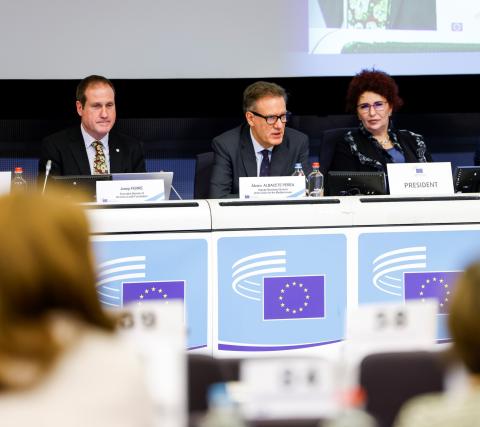
Na prosincovém plenárním zasedání EHSV proběhla diskuse věnovaná oživení a odolnosti evropsko-středomořského regionu po pandemii COVID-19, jež se zaměřila na digitální gramotnost.
Předsedkyně Výboru Christa Schweng poukázala na mimořádně důležitou úlohu, kterou plní regionální spolupráce a dialog a především síť organizací občanské společnosti. Za velice významné partnery EHSV a dva hlavní pilíře evropsko-středomořského partnerství označila Unii pro Středomoří a nadaci Anny Lindhové.
Náměstek generálního tajemníka Unie pro Středomoří Álvaro Albacete Perea a výkonný ředitel Euro-středomořské nadace Anny Lindhové pro dialog mezi kulturami Josep Ferré zdůraznili, že je naprosto zásadní posílit vztah mezi EU a oblastí jižního Středomoří.
Pro hospodářský a sociální pokrok v celém tomto regionu má stěžejní význam digitalizace. EHSV během tohoto plenárního zasedání přijal stanovisko z vlastní iniciativy Digitální transformace v evropsko-středomořském regionu, které vypracovala Dolores Sammut Bonnici a jež pojednává o tom, že je důležité zmenšit digitální propast mezi jednotlivými zeměmi, městskými a venkovskými oblastmi a mezi generacemi. (mp)