European Economic
and Social Committee
European Economic
and Social Committee
The European Economic and Social Committee (EESC) is the voice of organised civil society in Europe.
Find out more about its role and structure at http://www.eesc.europa.eu/en/about
The EESC issues between 160 and 190 opinions, evaluation and information reports a year.
It also organises several annual initiatives and events with a focus on civil society and citizens’ participation such as the Civil Society Prize, the Civil Society Days, the Your Europe, Your Say youth plenary and the ECI Day.
Find the latest EESC opinions and publications at http://www.eesc.europa.eu/en/our-work/opinions-information-reports/opinions and http://www.eesc.europa.eu/en/our-work/publications-other-work/publications respectively.
The EESC is active in a wide range of areas, from social affairs to economy, energy and sustainability.
Learn more about our policy areas and policy highlights at http://www.eesc.europa.eu/en/policies
The EESC holds nine plenary sessions per year. It also organises many conferences, public hearings and high-level debates related to its work.
Find out more about our upcoming events at http://www.eesc.europa.eu/en/agenda/our-events/upcoming-events
Here you can find news and information about the EESC'swork, including its social media accounts, the EESC Info newsletter, photo galleries and videos.
Read the latest EESC news http://www.eesc.europa.eu/en/news-media/news and press releases http://www.eesc.europa.eu/en/news-media/press-releases
The EESC brings together representatives from all areas of organised civil society, who give their independent advice on EU policies and legislation. The EESC's326 Members are organised into three groups: Employers, Workers and Various Interests.
Find out more about our Members and groups at http://www.eesc.europa.eu/en/members-groups
The EESC has six sections, specialising in concrete topics of relevance to the citizens of the European Union, ranging from social to economic affairs, energy, environment, external relations or the internal market.
Find out more at http://www.eesc.europa.eu/en/sections-other-bodies
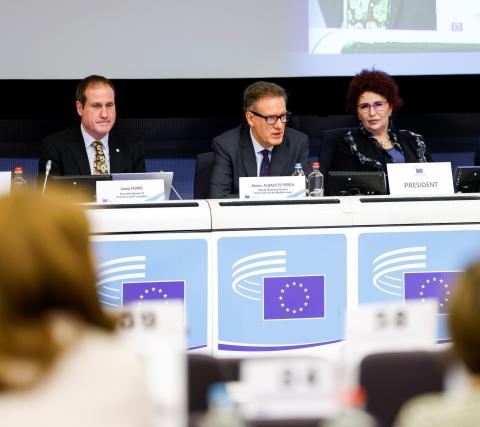
Vid EESK:s plenarsession i december hölls en debatt om återuppbyggnaden och motståndskraften i Europa–Medelhavsområdet efter covid-19-pandemin, med fokus på digital kompetens.
EESK:s ordförande Christa Schweng lyfte fram den viktiga roll som regionalt samarbete och regional dialog och särskilt nätverket av lokala civilsamhällesorganisationer spelar. Hon påpekade att Medelhavsunionen och Anna Lindhs stiftelse är mycket viktiga partner till EESK och två centrala pelare i Europa–Medelhavspartnerskapet.
Álvaro Albacete Perea, vice generalsekreterare för Medelhavsunionen, och Josep Ferré, verkställande direktör för Anna Lindhs Europa–Medelhavsstiftelse för kulturell dialog, betonade hur viktigt det är att stärka förbindelserna mellan EU och södra Medelhavsområdet.
Digitaliseringen är avgörande för den ekonomiska och sociala utvecklingen i hela Europa–Medelhavsområdet. I yttrandet på eget initiativ med titeln ”Den digitala omställningen i Europa–Medelhavsområdet”, som utarbetats av Dolores Sammut Bonnici och som antogs vid plenarsessionen, framhålls vikten av att minska den digitala klyftan mellan de olika länderna, mellan stads- och landsbygdsområdena och mellan generationerna. (mp)