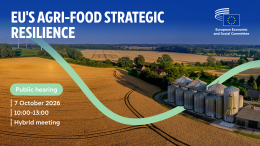
On Wednesday 7 October, from 10:00 - 13:00 CEST, the European Economic and Social Committee will host a public debate about the resilience of the EU's agri-food systems. This debate will focus on how to reduce the vulnerabilities and strategic dependencies of European food systems, increase the EU's readiness in the face of crisis, and learn from existing solutions.
In this overview the European Economic and Social Committee (EESC) shares its opinions on the European Commission’s proposals for the Multiannual Financial Framework (MFF) 2028-2034, bringing together the perspectives of organised civil society on the future direction of the EU budget.
Public debate in the ECO Section on the The international role of the euro: A European safe asset for a new geopolitical era?. This public debate will explore the opportunities and challenges associated with strengthening the international role of the euro and discuss the economic, financial and geopolitical arguments for and against the creation of a European safe asset.
rue Belliard 101, Jacques Delors building, room JDE 63, 9:30-11:00
Brussels
Belgium
EESC, room JDE 63, 9:30-11:00
The policy debate brings together stakeholders to assess how National and Regional and Partnership Plans will work in practice. In a workshop setting connected to the European Economic and Social Committee, participants from civil society, social partners and institutions will exchange perspectives on transparency, inclusiveness and impact. The discussion aims to highlight gaps, share best practices and strengthen the role of organised civil society in shaping and monitoring the implementation of NRPPs in the EU.
Public debate in the ECO Section on the The Multiannual Financial Framework after 2027 - Assessing progress and outstanding challenges. The event will take stock of developments in the negotiations since the Commission presented their proposals for the next Multiannual Financial Framework and discuss outstanding challenges.
The EU needs a long-term vision that takes greater account of geographic specificities. Sustainable water management and food security must become top priorities, with food security and biodiversity going hand in hand.
This public hearing will feed into the works on the own-initiative opinion which aims to clearly define social farming as an innovation in agriculture, highlighting its social impacts and to identify barriers to its development - such as legislative frameworks, recognition of services, financing, insurance, quality and safety, capacities and competences.
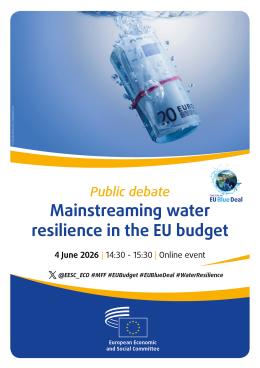
Mainstreaming Water Resilience in the EU Budget is a timely discussion on securing Europe’s water future. Discover how smarter EU investments can strengthen water resilience, sustainability, and preparedness, and how we should shape tomorrow’s funding priorities across programmes in the context of the EU´s next Multiannual Financial Framework.