Ameryka Łacińska i Karaiby

This page is also available in:

EKES współpracuje ze swoimi odpowiednikami w Ameryce Łacińskiej i na Karaibach od lat 90. XX wieku. Kilka opinii EKES-u skupiało uwagę na relacjach z tym regionem, na szczeblu regionalnym, subregionalnym i krajowym. Priorytety EKES-u obejmują rozwój organizacji społeczeństwa obywatelskiego, rozwój gospodarczy i społeczny, integrację regionalną i współpracę wielostronną.

Na szczeblu regionalnym EKES organizuje co dwa lata posiedzenia między przedstawicielami społeczeństwa obywatelskiego w Europie, Ameryce Łacińskiej i na Karaibach jako jedno z wydarzeń przygotowawczych przed szczytem UE–CELAC. 

Na szczeblu subregionalnym i krajowym ustanowiono kilka stałych struktur: w 2009 r. EKES ustanowił okrągły stół społeczeństwa obywatelskiego z Radą Rozwoju Społeczno-Gospodarczego Brazylii, aby zapewnić przedstawicielom społeczeństwa obywatelskiego Brazylii i UE forum dla dialogu i stałej współpracy. Układ o stowarzyszeniu między UE a Chile przyznał Komitetowi mandat do powołania Wspólnego Komitetu Konsultacyjnego wraz ze swoim chilijskim odpowiednikiem reprezentującym społeczeństwo obywatelskie, aby monitorować ten układ; komitet ten został ostatecznie powołany w 2016 r. Jeśli chodzi i kraje Wspólnoty Andyjskiej, EKES uczestniczy w pracach wewnętrznej grupy doradczej monitorującej realizację porozumienia o wolnym handlu UE-Kolumbia/Peru/Ekwador. EKES uczestniczy też w pracach Komitetu Konsultacyjnego CARIFORUM–UE, który monitoruje realizację umowy o partnerstwie gospodarczym CARIFORUM–UE. Ustanowiono stałe relacje z instytucjonalnymi odpowiednikami EKES-u w państwach Mercosuru (Konsultacyjne Forum Ekonomiczno-Społeczne) i w Ameryce Środkowej (Komitet Konsultacyjny Systemu Integracyjnego Ameryki Środkowej).

  • A new social contract for Latin America is needed, ensuring political accountability, inclusion, social protection and quality employment, said the European Economic and Social Committee (EESC) in its own-initiative opinion on the socio-economic situation in Latin America, following the pandemic. Freely and democratically organised civil societies are the best starting point.

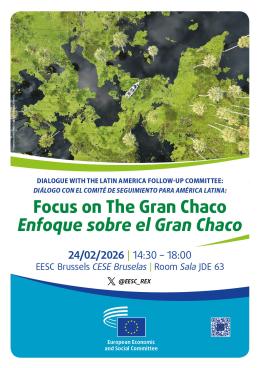
  • The afternoon session of the Latin America Follow-up Committee meeting to be held on 24 February 2026 will be dedicated to the Gran Chaco. Organised in collaboration with the multi-actor platform Redes Chaco, the network implementing the EU-supported Impacto Verde initiative, this dialogue will spotlight the challenges and opportunities linking the American Gran Chaco to the EU-Latin America agenda.

  • -

    Driven by the collaboration between the European Economic and Social Committee (EESC) and the Brazilian Economic and Social Development Council (CDES), the EU-Brazil Civil Society Round Table held eight meetings between 2009 and 2014. Following the re-establishment of Brazil’s civil society advisory body in 2023 – now operating as the Sustainable Economic and Social Development Council of Brazil (CDESS) – and in accordance with the EESC-CDESS Memorandum of Understanding signed on 9 April 2024 in Brasília, as well as the Joint Statement issued by the President of the EESC and the Minister of Institutional Relations of Brazil on 10 April 2024, the EU-Brazil Civil Society Round Table has been officially reactivated.

  • Event type
    Meeting

    The 8th meeting of the CARIFORUM-EU Consultative Committee took place in Nassau, bringing together civil society representatives from the Caribbean and the European Union. The agenda covered key discussions on the 5-year review of the CARIFORUM-EU Economic Partnership Agreement (EPA), its impact on trade, SMEs, and labour standards, as well as the evolving situation in Haiti. Participants engaged in high-level dialogues, expert briefings, and the adoption of a Joint Statement, shaping the future of CARIFORUM-EU cooperation.

  • -

    The EESC participates in the important event on labour, organized by the European Commission (DG EMPL). The Conference creates an opportunity to exchange views on how to strengthen compliance with labour rights and promote decent working conditions, with a particular focus on freedom of association, combating informality at work in rural areas and eradicating child labour.

  • Event type
    Joint meeting

    The CARIFORUM-EU Consultative Committee (CC) was established with the task and responsibility of fostering meaningful dialogue and collaboration among delegates from civil society organizations, including the academic community, and social and economic stakeholders.

  • The agenda of the 10th hybrid meeting of the JCC includes the presentation of the ongoing work objectives, as well as the discussion on the EU-Chile Advanced Framework Agreement, in particular the state of play of the ratification process and the role of the civil society under the renewed deal.

  • -
    Event type
    Joint meeting

    EU-Central America joint meeting of civil society Advisory Groups and Civil Society Dialogue Forum

  • 12 December 2022 - Hybrid Brussels


  • 18th meeting of the EU - DAG Colombia-Peru-Ecuador

    17 October 2022 - Hybrid Brussels