European Economic
and Social Committee
European Economic
and Social Committee
The European Economic and Social Committee (EESC) is the voice of organised civil society in Europe.
Find out more about its role and structure at http://www.eesc.europa.eu/en/about
The EESC issues between 160 and 190 opinions, evaluation and information reports a year.
It also organises several annual initiatives and events with a focus on civil society and citizens’ participation such as the Civil Society Prize, the Civil Society Days, the Your Europe, Your Say youth plenary and the ECI Day.
Find the latest EESC opinions and publications at http://www.eesc.europa.eu/en/our-work/opinions-information-reports/opinions and http://www.eesc.europa.eu/en/our-work/publications-other-work/publications respectively.
The EESC is active in a wide range of areas, from social affairs to economy, energy and sustainability.
Learn more about our policy areas and policy highlights at http://www.eesc.europa.eu/en/policies
The EESC holds nine plenary sessions per year. It also organises many conferences, public hearings and high-level debates related to its work.
Find out more about our upcoming events at http://www.eesc.europa.eu/en/agenda/our-events/upcoming-events
Here you can find news and information about the EESC'swork, including its social media accounts, the EESC Info newsletter, photo galleries and videos.
Read the latest EESC news http://www.eesc.europa.eu/en/news-media/news and press releases http://www.eesc.europa.eu/en/news-media/press-releases
The EESC brings together representatives from all areas of organised civil society, who give their independent advice on EU policies and legislation. The EESC's326 Members are organised into three groups: Employers, Workers and Various Interests.
Find out more about our Members and groups at http://www.eesc.europa.eu/en/members-groups
The EESC has six sections, specialising in concrete topics of relevance to the citizens of the European Union, ranging from social to economic affairs, energy, environment, external relations or the internal market.
Find out more at http://www.eesc.europa.eu/en/sections-other-bodies
Kommittén stöder inrättandet av en framtida elmarknad som bygger på ett offentlig-privat partnerskap och en kombination av reglering och avreglering.
I centrum för denna modell står inrättandet av en statlig ”e-facilitet” som köper el från producenterna och säljer den till leverantörer till hushållskunder, små och medelstora företag, medborgarenergigemenskaper, storkonsumenter och, när det är lämpligt och möjligt, till andra länder.
Denna e-facilitet kan ingå långfristiga avtal med elproducenter som tecknas genom anbudsförfaranden. Avtalen kan vara av olika slag, t.ex. energiköpsavtal, differenskontrakt (CFD) och avtal på löpande räkning.
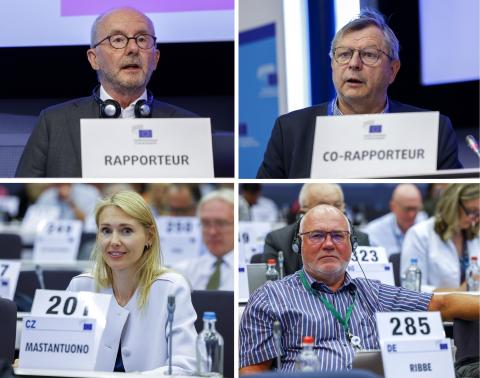
Detta är en viktig reform som bör genomföras på EU:s nuvarande elmarknad, i enlighet med det EESK-yttrande som utarbetats av Jan Dirx och Christophe Quarez och som antogs vid plenarsessionen den 14 juni 2023.
”Kommittén har sedan länge förespråkat en reform av elmarknaden i EU”, sade Jan Dirx. ”Vi menar att vägen framåt är en hybridmodell som bygger på principen att avreglera där så är möjligt och reglera där så krävs.”
”Energi är en hörnsten i vårt ekonomiska och sociala system och bör inte behandlas som vilken annan vara som helst. Energi är en central del av de offentliga tjänsterna”, underströk Christophe Quarez. ”I vårt förslag är regeringen ansvarig för att uppnå målen om hållbarhet, överkomliga priser och försörjningstrygghet.”