European Economic
and Social Committee
European Economic
and Social Committee
The European Economic and Social Committee (EESC) is the voice of organised civil society in Europe.
Find out more about its role and structure at http://www.eesc.europa.eu/en/about
The EESC issues between 160 and 190 opinions, evaluation and information reports a year.
It also organises several annual initiatives and events with a focus on civil society and citizens’ participation such as the Civil Society Prize, the Civil Society Days, the Your Europe, Your Say youth plenary and the ECI Day.
Find the latest EESC opinions and publications at http://www.eesc.europa.eu/en/our-work/opinions-information-reports/opinions and http://www.eesc.europa.eu/en/our-work/publications-other-work/publications respectively.
The EESC is active in a wide range of areas, from social affairs to economy, energy and sustainability.
Learn more about our policy areas and policy highlights at http://www.eesc.europa.eu/en/policies
The EESC holds nine plenary sessions per year. It also organises many conferences, public hearings and high-level debates related to its work.
Find out more about our upcoming events at http://www.eesc.europa.eu/en/agenda/our-events/upcoming-events
Here you can find news and information about the EESC'swork, including its social media accounts, the EESC Info newsletter, photo galleries and videos.
Read the latest EESC news http://www.eesc.europa.eu/en/news-media/news and press releases http://www.eesc.europa.eu/en/news-media/press-releases
The EESC brings together representatives from all areas of organised civil society, who give their independent advice on EU policies and legislation. The EESC's326 Members are organised into three groups: Employers, Workers and Various Interests.
Find out more about our Members and groups at http://www.eesc.europa.eu/en/members-groups
The EESC has six sections, specialising in concrete topics of relevance to the citizens of the European Union, ranging from social to economic affairs, energy, environment, external relations or the internal market.
Find out more at http://www.eesc.europa.eu/en/sections-other-bodies
El Comité apoya la creación de un futuro mercado de la electricidad basado en una asociación público-privada y en una combinación de regulación y liberalización.
La esencia de este modelo es un «mecanismo para la electricidad» instaurado por el gobierno que compre la electricidad a los productores y la venda a los proveedores de hogares, pymes, comunidades ciudadanas de energía, grandes consumidores y, cuando sea posible y conveniente, a otros países.
El «mecanismo para la electricidad» celebraría contratos a largo plazo con los productores de electricidad sobre la base de licitaciones. Tales contratos serían de diversos tipos, como contratos de compra de energía (CCE), contratos por diferencia y contratos de margen fijo.
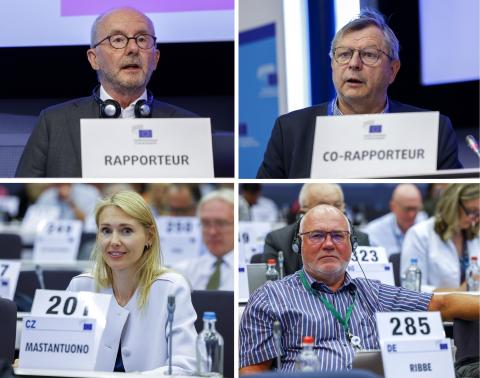
Tal como se afirma en el Dictamen del CESE elaborado por Jan Dirx y Christophe Quarez y aprobado en el pleno del CESE del 14 de junio de 2023, esta es la principal reforma que debe llevarse a cabo en el actual mercado de la electricidad de la UE.
El Sr. Dirx declaró: «El Comité lleva defendiendo desde hace tiempo la reforma del mercado de la electricidad de la UE. Creemos que un modelo híbrido basado en el lema “liberalizar siempre que se pueda y regular cuando sea necesario” constituye una vía de avance».
«La energía es un componente esencial de nuestro sistema económico y social y no debe considerarse como cualquier otra mercancía. La energía es un elemento fundamental de la prestación de servicios públicos», subrayó el Sr. Quarez. «Con nuestra propuesta, el Gobierno es responsable de lograr los objetivos de sostenibilidad, asequibilidad y seguridad del suministro». (mp)