European Economic
and Social Committee
European Economic
and Social Committee
The European Economic and Social Committee (EESC) is the voice of organised civil society in Europe.
Find out more about its role and structure at http://www.eesc.europa.eu/en/about
The EESC issues between 160 and 190 opinions, evaluation and information reports a year.
It also organises several annual initiatives and events with a focus on civil society and citizens’ participation such as the Civil Society Prize, the Civil Society Days, the Your Europe, Your Say youth plenary and the ECI Day.
Find the latest EESC opinions and publications at http://www.eesc.europa.eu/en/our-work/opinions-information-reports/opinions and http://www.eesc.europa.eu/en/our-work/publications-other-work/publications respectively.
The EESC is active in a wide range of areas, from social affairs to economy, energy and sustainability.
Learn more about our policy areas and policy highlights at http://www.eesc.europa.eu/en/policies
The EESC holds nine plenary sessions per year. It also organises many conferences, public hearings and high-level debates related to its work.
Find out more about our upcoming events at http://www.eesc.europa.eu/en/agenda/our-events/upcoming-events
Here you can find news and information about the EESC'swork, including its social media accounts, the EESC Info newsletter, photo galleries and videos.
Read the latest EESC news http://www.eesc.europa.eu/en/news-media/news and press releases http://www.eesc.europa.eu/en/news-media/press-releases
The EESC brings together representatives from all areas of organised civil society, who give their independent advice on EU policies and legislation. The EESC's326 Members are organised into three groups: Employers, Workers and Various Interests.
Find out more about our Members and groups at http://www.eesc.europa.eu/en/members-groups
The EESC has six sections, specialising in concrete topics of relevance to the citizens of the European Union, ranging from social to economic affairs, energy, environment, external relations or the internal market.
Find out more at http://www.eesc.europa.eu/en/sections-other-bodies
Der Ausschuss spricht sich für einen künftigen Strommarkt auf der Basis einer öffentlich-privaten Partnerschaft sowie für eine Mischung aus Regulierung und Liberalisierung aus.
Kern des vom EWSA vorgeschlagenen Modells ist eine von den Regierungen einzurichtende „E-Agentur“, die Strom von den Erzeugern kauft und an diejenigen verkauft, die Haushalte, KMU, Bürgerenergiegemeinschaften und Großverbraucher beliefern, sowie gegebenenfalls und sofern möglich an andere Länder.
Die „E-Agentur“ soll langfristige Verträge mit Stromerzeugern auf der Basis von Ausschreibungen abschließen. Dabei sollen unterschiedliche Arten von Verträgen genutzt werden, beispielsweise Strombezugsverträge, Differenzverträge und Kosten-Plus-Verträge.
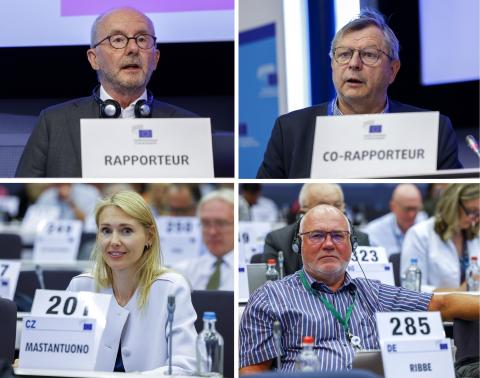
Dies sind die zentralen Elemente für eine Reform des derzeitigen EU-Strommarkts, die die beiden EWSA-Berichterstatter Jan Dirx und Christophe Quarez in der Stellungnahme vorschlagen, die auf der Plenartagung am 14. Juni 2023 verabschiedet wurde.
„Der EWSA spricht sich seit Langem für eine Reform des EU-Strommarkts aus“, so Jan Dirx. „Wir sind der Auffassung, dass ein hybrides Modell gemäß dem Motto ‚so viel Liberalisierung wie möglich, so viel Regulierung wie nötig‘ zukunftsweisend wäre“.
„Energie ist ein wesentlicher Baustein unseres Wirtschafts- und Sozialsystems und sollte nicht wie eine gewöhnliche Ware behandelt werden, denn sie ist ein zentraler Bestandteil der öffentlichen Dienstleistungen“, betonte Christophe Quarez. „Gemäß unserem Vorschlag sind die Regierungen für die Verwirklichung der Ziele Nachhaltigkeit, Erschwinglichkeit und Versorgungssicherheit verantwortlich.“ (mp)