European Economic
and Social Committee
European Economic
and Social Committee
The European Economic and Social Committee (EESC) is the voice of organised civil society in Europe.
Find out more about its role and structure at http://www.eesc.europa.eu/en/about
The EESC issues between 160 and 190 opinions, evaluation and information reports a year.
It also organises several annual initiatives and events with a focus on civil society and citizens’ participation such as the Civil Society Prize, the Civil Society Days, the Your Europe, Your Say youth plenary and the ECI Day.
Find the latest EESC opinions and publications at http://www.eesc.europa.eu/en/our-work/opinions-information-reports/opinions and http://www.eesc.europa.eu/en/our-work/publications-other-work/publications respectively.
The EESC is active in a wide range of areas, from social affairs to economy, energy and sustainability.
Learn more about our policy areas and policy highlights at http://www.eesc.europa.eu/en/policies
The EESC holds nine plenary sessions per year. It also organises many conferences, public hearings and high-level debates related to its work.
Find out more about our upcoming events at http://www.eesc.europa.eu/en/agenda/our-events/upcoming-events
Here you can find news and information about the EESC'swork, including its social media accounts, the EESC Info newsletter, photo galleries and videos.
Read the latest EESC news http://www.eesc.europa.eu/en/news-media/news and press releases http://www.eesc.europa.eu/en/news-media/press-releases
The EESC brings together representatives from all areas of organised civil society, who give their independent advice on EU policies and legislation. The EESC's326 Members are organised into three groups: Employers, Workers and Various Interests.
Find out more about our Members and groups at http://www.eesc.europa.eu/en/members-groups
The EESC has six sections, specialising in concrete topics of relevance to the citizens of the European Union, ranging from social to economic affairs, energy, environment, external relations or the internal market.
Find out more at http://www.eesc.europa.eu/en/sections-other-bodies
Le Comité approuve la création à l’avenir d’un marché de l’électricité qui se fonde sur un partenariat public-privé et qui allie réglementation et libéralisation.
Ce modèle s’axe sur un «service complémentaire essentiel» mis en place par les pouvoirs publics, qui achèterait l’électricité aux producteurs et la revendrait aux acteurs qui la fournissent aux ménages, aux PME et aux communautés énergétiques citoyennes, ainsi qu’aux grands consommateurs et, lorsqu’il est opportun et possible de le faire, à d’autres pays.
Ce «service complémentaire essentiel» conclurait des contrats à long terme avec les producteurs d’électricité sur la base d’appels d’offres. Les contrats afférents seraient de différents types, tels que des accords d’achat d’électricité (AAE), des contrats d’écart compensatoire (CEC) et des contrats à prix coûtant majoré.
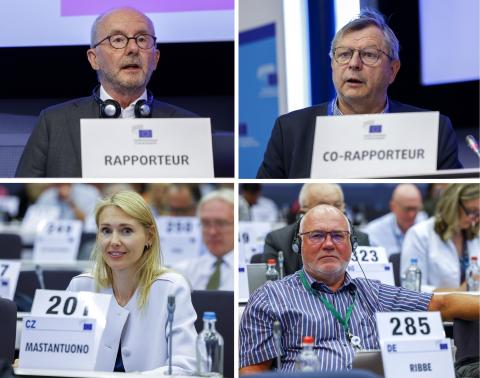
L’avis du CESE, élaboré par Jan Dirx et Christophe Quarez et adopté lors de sa session plénière le 14 juin 2023, estime qu’il s’agit là de la réforme essentielle qu’il convient d’apporter au marché actuel de l’électricité de l’Union européenne.
«Le Comité est partisan de longue date d’une réforme du marché de l’électricité de l’Union européenne», a déclaré M. Dirx. «Nous pensons que la voie à suivre prend la forme d’un modèle hybride fondé sur le principe de “libéraliser dès que possible et réglementer dès que nécessaire”».
L’énergie est une pièce maîtresse de notre système économique et social et ne saurait être traitée comme n’importe quelle autre marchandise. «L’énergie est un élément central des services publics», a fait valoir M. Quarez. «Notre proposition confère aux pouvoirs publics la responsabilité de réaliser les objectifs que sont la durabilité, le caractère abordable des prix et la sécurité de l’approvisionnement.» (mp)