European Economic
and Social Committee
European Economic
and Social Committee
The European Economic and Social Committee (EESC) is the voice of organised civil society in Europe.
Find out more about its role and structure at http://www.eesc.europa.eu/en/about
The EESC issues between 160 and 190 opinions, evaluation and information reports a year.
It also organises several annual initiatives and events with a focus on civil society and citizens’ participation such as the Civil Society Prize, the Civil Society Days, the Your Europe, Your Say youth plenary and the ECI Day.
Find the latest EESC opinions and publications at http://www.eesc.europa.eu/en/our-work/opinions-information-reports/opinions and http://www.eesc.europa.eu/en/our-work/publications-other-work/publications respectively.
The EESC is active in a wide range of areas, from social affairs to economy, energy and sustainability.
Learn more about our policy areas and policy highlights at http://www.eesc.europa.eu/en/policies
The EESC holds nine plenary sessions per year. It also organises many conferences, public hearings and high-level debates related to its work.
Find out more about our upcoming events at http://www.eesc.europa.eu/en/agenda/our-events/upcoming-events
Here you can find news and information about the EESC'swork, including its social media accounts, the EESC Info newsletter, photo galleries and videos.
Read the latest EESC news http://www.eesc.europa.eu/en/news-media/news and press releases http://www.eesc.europa.eu/en/news-media/press-releases
The EESC brings together representatives from all areas of organised civil society, who give their independent advice on EU policies and legislation. The EESC's326 Members are organised into three groups: Employers, Workers and Various Interests.
Find out more about our Members and groups at http://www.eesc.europa.eu/en/members-groups
The EESC has six sections, specialising in concrete topics of relevance to the citizens of the European Union, ranging from social to economic affairs, energy, environment, external relations or the internal market.
Find out more at http://www.eesc.europa.eu/en/sections-other-bodies
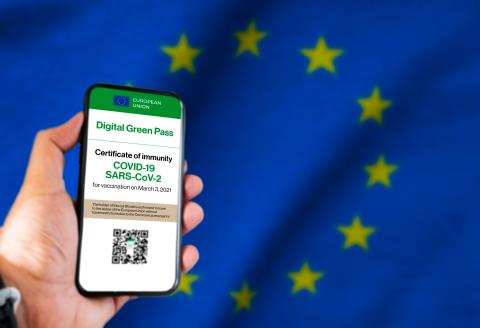
Uplatňovanie jednej zo základných hodnôt EÚ bolo viac ako rok pozastavené, no osvedčenie EÚ pre COVID-19, ako bolo premenované „digitálne zelené osvedčenie“ navrhnuté Komisiou, teraz otvára cestu voľnému a bezpečnému pohybu v rámci Európy. EHSV víta zavedenie osvedčenia ako vynikajúcu spoločnú normu na zjednodušenie a uľahčenie pohybu cestujúcich, pokiaľ sa v plnom rozsahu dodržia základné práva a požiadavky na ochranu údajov.
EHSV vo svojom stanovisku poukazuje na to, že osvedčenie uľahčí ľuďom cestovanie, ale navrhovaným nariadením sa nestanovuje povinnosť zaočkovať sa ani právo na očkovanie. „Toto osvedčenie musí byť transparentné a musí zaručiť ochranu nášho súkromného života,“ zdôrazňuje spravodajca stanoviska George Vernicos.
Sociálne a etické aspekty, ktoré sa majú zohľadniť
Osvedčenie potvrdí nielen to, že osoba bola zaočkovaná, ale poskytne i aktuálne výsledky PCR testu alebo informáciu o prekonaní infekcie SARS-CoV-2.
Vnútroštátne orgány musia zabezpečiť jeho rýchle, bezplatné a nediskriminačné zavedenie. EHSV tiež zdôrazňuje, že osvedčenie nesmie viesť k diskriminácii na pracovisku ani otvárať dvere mzdovému dumpingu zamestnávaním očkovaných osôb z tretích krajín.
Osobitná pozornosť by sa mala venovať ochrane osobných údajov, a preto je kľúčové, aby všetky členské štáty mali interoperabilné systémy s rovnako prísnymi ustanoveniami na ochranu údajov. (at)