European Economic
and Social Committee
European Economic
and Social Committee
The European Economic and Social Committee (EESC) is the voice of organised civil society in Europe.
Find out more about its role and structure at http://www.eesc.europa.eu/en/about
The EESC issues between 160 and 190 opinions, evaluation and information reports a year.
It also organises several annual initiatives and events with a focus on civil society and citizens’ participation such as the Civil Society Prize, the Civil Society Days, the Your Europe, Your Say youth plenary and the ECI Day.
Find the latest EESC opinions and publications at http://www.eesc.europa.eu/en/our-work/opinions-information-reports/opinions and http://www.eesc.europa.eu/en/our-work/publications-other-work/publications respectively.
The EESC is active in a wide range of areas, from social affairs to economy, energy and sustainability.
Learn more about our policy areas and policy highlights at http://www.eesc.europa.eu/en/policies
The EESC holds nine plenary sessions per year. It also organises many conferences, public hearings and high-level debates related to its work.
Find out more about our upcoming events at http://www.eesc.europa.eu/en/agenda/our-events/upcoming-events
Here you can find news and information about the EESC'swork, including its social media accounts, the EESC Info newsletter, photo galleries and videos.
Read the latest EESC news http://www.eesc.europa.eu/en/news-media/news and press releases http://www.eesc.europa.eu/en/news-media/press-releases
The EESC brings together representatives from all areas of organised civil society, who give their independent advice on EU policies and legislation. The EESC's326 Members are organised into three groups: Employers, Workers and Various Interests.
Find out more about our Members and groups at http://www.eesc.europa.eu/en/members-groups
The EESC has six sections, specialising in concrete topics of relevance to the citizens of the European Union, ranging from social to economic affairs, energy, environment, external relations or the internal market.
Find out more at http://www.eesc.europa.eu/en/sections-other-bodies
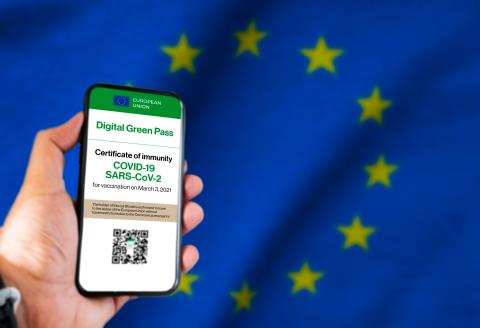
Ett av EU:s grundläggande värden har varit satt på paus i över ett år, men nu banar EU:s covid-19-intyg, i stället för det ”digitala gröna intyg” som föreslogs av kommissionen, vägen för en fri och säker rörlighet inom Europa. EESK välkomnar införandet av intyget som en utmärkt gemensam standard för att minimera problemen för resenärer och underlätta deras resor, under förutsättning att grundläggande rättigheter och dataskyddskrav respekteras fullt ut.
I sitt yttrande vidhåller EESK att intyget kommer att göra det enklare för resenärer att resa, men förslaget till förordning fastställer inget krav på eller rätt att bli vaccinerad. ”Detta intyg måste vara insynsvänligt och värna vårt privatliv”, underströk föredraganden för yttrandet, George Vernicos.
Sociala och etiska aspekter måste beaktas
Intyget kommer inte bara att vara ett bevis på huruvida en person har blivit vaccinerad utan även visa resultat av färska PCR-test och information om en persons tillfrisknande från en SARS-CoV-2-infektion.
De nationella myndigheterna måste säkerställa ett snabbt och kostnadsfritt införande av intyget, utan diskriminering. EESK understryker även att intyget inte får leda till diskriminering på arbetsplatsen eller bana väg för lönedumpning genom anställning av vaccinerade personer från tredjeländer.
Särskild uppmärksamhet bör riktas mot skyddet av personuppgifter, varför det är ytterst viktigt att medlemsstaterna har interoperabla system med lika stränga dataskyddsbestämmelser. (at)