European Economic
and Social Committee
European Economic
and Social Committee
The European Economic and Social Committee (EESC) is the voice of organised civil society in Europe.
Find out more about its role and structure at http://www.eesc.europa.eu/en/about
The EESC issues between 160 and 190 opinions, evaluation and information reports a year.
It also organises several annual initiatives and events with a focus on civil society and citizens’ participation such as the Civil Society Prize, the Civil Society Days, the Your Europe, Your Say youth plenary and the ECI Day.
Find the latest EESC opinions and publications at http://www.eesc.europa.eu/en/our-work/opinions-information-reports/opinions and http://www.eesc.europa.eu/en/our-work/publications-other-work/publications respectively.
The EESC is active in a wide range of areas, from social affairs to economy, energy and sustainability.
Learn more about our policy areas and policy highlights at http://www.eesc.europa.eu/en/policies
The EESC holds nine plenary sessions per year. It also organises many conferences, public hearings and high-level debates related to its work.
Find out more about our upcoming events at http://www.eesc.europa.eu/en/agenda/our-events/upcoming-events
Here you can find news and information about the EESC'swork, including its social media accounts, the EESC Info newsletter, photo galleries and videos.
Read the latest EESC news http://www.eesc.europa.eu/en/news-media/news and press releases http://www.eesc.europa.eu/en/news-media/press-releases
The EESC brings together representatives from all areas of organised civil society, who give their independent advice on EU policies and legislation. The EESC's326 Members are organised into three groups: Employers, Workers and Various Interests.
Find out more about our Members and groups at http://www.eesc.europa.eu/en/members-groups
The EESC has six sections, specialising in concrete topics of relevance to the citizens of the European Union, ranging from social to economic affairs, energy, environment, external relations or the internal market.
Find out more at http://www.eesc.europa.eu/en/sections-other-bodies
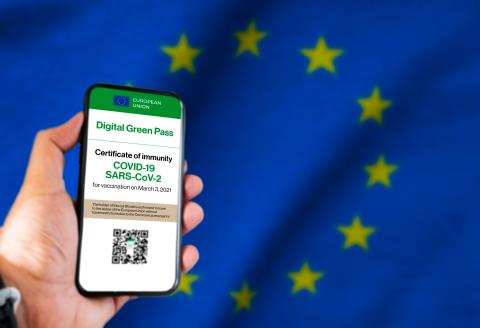
Eine der Grundfreiheiten der EU, die Personenfreizügigkeit, ist seit über einem Jahr ausgesetzt. Nun soll das von der Kommission vorgeschlagene „digitale grüne Zertifikat“, das in „COVID-19-Zertifikat der EU“ umbenannt wurde, wieder den Weg für freies und sicheres Reisen innerhalb Europas ebnen. Der EWSA begrüßt die Einführung des Zertifikats als ausgezeichnetem gemeinsamen Standard, der Vereinfachungen für Reisende bringt und die Freizügigkeit erleichtert, unter der Voraussetzung, dass die Grundrechte und der Datenschutz vollständig gewahrt werden.
In seiner Stellungnahme vertritt er die Auffassung, dass das Zertifikat zwar das Reisen erleichtert, die vorgeschlagene Verordnung jedoch keine Impfpflicht und auch kein Recht auf Impfung begründet. „Das Zertifikat muss transparent sein und den Schutz unserer Privatsphäre gewährleisten“, betont Berichterstatter George Vernicos.
Soziale und ethische Aspekte müssen berücksichtigt werden
Das Zertifikat dient nicht nur dem Nachweis einer Impfung, sondern umfasst auch Informationen über die Ergebnisse kürzlich durchgeführter PCR-Tests bzw. über eine Genesung von einer Infektion mit dem Coronavirus.
Die nationalen Behörden müssen für dessen rasche, kostenlose und vollständig diskriminierungsfreie Einführung sorgen. Zudem weist der EWSA nachdrücklich darauf hin, dass es weder zu Diskriminierung am Arbeitsplatz noch zu Lohndumping durch die Beschäftigung von Geimpften aus Drittstaaten führen darf.
Besonderes Augenmerk muss auf den Datenschutz gelegt werden, weshalb es entscheidend darauf ankommt, dass alle Mitgliedstaaten über interoperable Systeme mit identisch strengen Datenschutzvorschriften verfügen. (at)