European Economic
and Social Committee
European Economic
and Social Committee
The European Economic and Social Committee (EESC) is the voice of organised civil society in Europe.
Find out more about its role and structure at http://www.eesc.europa.eu/en/about
The EESC issues between 160 and 190 opinions, evaluation and information reports a year.
It also organises several annual initiatives and events with a focus on civil society and citizens’ participation such as the Civil Society Prize, the Civil Society Days, the Your Europe, Your Say youth plenary and the ECI Day.
Find the latest EESC opinions and publications at http://www.eesc.europa.eu/en/our-work/opinions-information-reports/opinions and http://www.eesc.europa.eu/en/our-work/publications-other-work/publications respectively.
The EESC is active in a wide range of areas, from social affairs to economy, energy and sustainability.
Learn more about our policy areas and policy highlights at http://www.eesc.europa.eu/en/policies
The EESC holds nine plenary sessions per year. It also organises many conferences, public hearings and high-level debates related to its work.
Find out more about our upcoming events at http://www.eesc.europa.eu/en/agenda/our-events/upcoming-events
Here you can find news and information about the EESC'swork, including its social media accounts, the EESC Info newsletter, photo galleries and videos.
Read the latest EESC news http://www.eesc.europa.eu/en/news-media/news and press releases http://www.eesc.europa.eu/en/news-media/press-releases
The EESC brings together representatives from all areas of organised civil society, who give their independent advice on EU policies and legislation. The EESC's326 Members are organised into three groups: Employers, Workers and Various Interests.
Find out more about our Members and groups at http://www.eesc.europa.eu/en/members-groups
The EESC has six sections, specialising in concrete topics of relevance to the citizens of the European Union, ranging from social to economic affairs, energy, environment, external relations or the internal market.
Find out more at http://www.eesc.europa.eu/en/sections-other-bodies
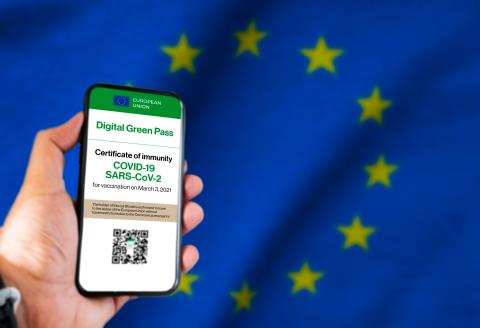
Meer dan een jaar lang stond er een rem op het vrije verkeer in Europa, een kernwaarde van de EU. Met het EU-COVID-19-certificaat, dat in de plaats komt van het door de Commissie voorgestelde digitaal groen certificaat, wordt nu het pad geëffend voor vrij en veilig verkeer binnen Europa. Het EESC juicht de invoering toe van het certificaat, dat een uitstekende gemeenschappelijke standaard is die het leven voor reizigers eenvoudiger zal maken, maar benadrukt dat de grondrechten en de vereisten voor gegevensbescherming ten volle moeten worden gerespecteerd.
Het EESC stelt in zijn advies dat reizigers dankzij het certificaat gemakkelijker zullen kunnen reizen, terwijl de voorgestelde verordening niet tot een vaccinatieplicht leidt of een recht om te worden gevaccineerd. "Het certificaat moet transparant zijn en moet onze privacy beschermen," benadrukt George Vernicos, de rapporteur voor het advies.
Er moet rekening worden gehouden met sociale en ethische aspecten.
Het certificaat zal vermelden of een persoon is gevaccineerd en zal de resultaten van recente PCR-testen bevatten, evenals informatie over het herstel van een persoon na een SARS-CoV-2-infectie.
De nationale overheden moeten ervoor zorgen dat het certificaat snel en kosteloos ter beschikking wordt gesteld, zonder enige vorm van discriminatie. Het EESC benadrukt ook dat het certificaat niet tot discriminatie op de werkplek mag leiden en dat loondumping moet worden voorkomen, waarbij gevaccineerde mensen uit derde landen worden tewerkgesteld.
Bijzondere aandacht moet worden besteed aan gegevensbescherming en het is dan ook van essentieel belang dat de lidstaten over interoperabele systemen met even strenge bepalingen op het gebied van gegevensbescherming beschikken. (at)