
European Economic
and Social Committee
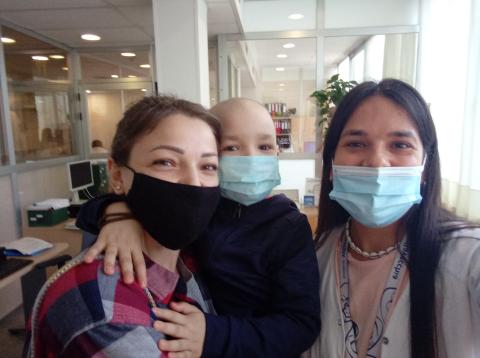
When the news about the evacuation of children with cancer from Ukraine reached the Villavecchia Foundation, its staff did not hesitate for a second. They immediately volunteered to welcome and assist the children and their families. But to be able to give these children the adequate care and support they really needed, the foundation had to team up with hospitals and many other entities and volunteers. Together, they managed to create a safe place for the young patients in Barcelona. Natàlia Ferrer Ametller shared their story with us.
EESC info: What prompted you to start your project or initiative?
We were informed that children with cancer were being evacuated from Ukraine and we offered our help to the administrations involved and to the international organisation that was managing the evacuation. When we were tasked with organising the whole operation, we received immediate support from the Josep Carreras International Foundation with a view to us managing the whole operation together. Many other entities offered to help. We did not hesitate for a second; we had to help in those areas where we were able to do so: welcoming and assisting children with cancer and supporting their families, in coordination with the referral hospitals.
How was your project received? Did you have any feedback from the people you helped? (Can you give an example if you have one?)
It was a very intense experience and we learned many things. Above all, we learned about the harsh situations of refugees. The biggest difficulty was the language, as well as some cultural aspects. However, we had help from many volunteers, who did tremendous work as interpreters, accompanying children during all their hospital stays, ambulance rides, visits and formalities. Many treatments have progressed very well and many children have already completed their acute treatment and are in the maintenance phase. Some of them have been able to return home. For example, here is a picture of one of the children, Mykola, and his mother, together with our hospital social worker. We went through a very difficult time together and the best gift was the children's smiles and their mothers' sense of calm.
How will you use this specific funding to provide further help in the community?
To continue working. We have three families whose children are still at an acute stage due to complications with their treatment. They need housing, maintenance, travel, medication assistance, translation, etc., and the rest of the families need to continue to feel that we remain close at hand.
Are you already planning new projects?
Yes, we are working to create the Victoria Pavilion, which is a paediatric hospice and the first of its kind in Spain. This will be a place to care for children with diseases that cannot be cured who are at advanced stages or in their last days of life. We will renovate a historic building in a very emblematic place in the Sant Pau Hospital in Barcelona.
What advice would you give to other organisations in terms of achieving results with such activities and programmes?
We believe that it is very important to clearly identify needs and to design projects that address what needs to be addressed, however difficult it may be. You need to know how to listen, learn, accept help and team up with other entities that work in a complementary way. You need to appreciate the work of others and all move towards the same goal together.
Do you see solidarity fatigue with Ukrainian refugees kicking in if the war in Ukraine persists?
Unfortunately, current events quickly become old news and the solidarity they generate can be short-lived. However, it is also true that people have a lot of capacity to persist and to fight for rights and social justice.
What can and should civil society organisations do to prevent this from happening?
Call on the authorities to continue to provide aid and to strengthen the role of social bodies.
Could the EU play a positive role in this regard?
Yes, by promoting recommendations at European level for governments and administrations to work together and facilitate the work of the relevant bodies. It won't work if we have administrations working on one side and bodies on another, with no link between them. Public administrations need civil society and the latter cannot and should not be isolated. Many social bodies have been working without the support of public administrations. We know that being open and working in a network requires effort, but also that there is absolutely an opportunity to work together.