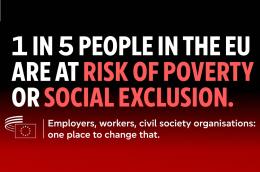
Poverty is not simply a lack of income. It can mean being unable to afford food, heating, healthcare or secure housing, or to participate fully in society. To mark the International Day for the Eradication of Poverty, the European Economic and Social Committee (EESC) highlights its longstanding call for coordinated European action to tackle its many interconnected causes.
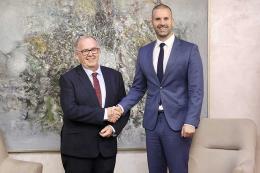
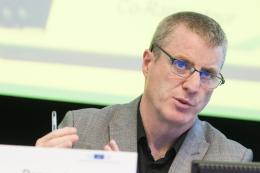
From 7 to 9 October 2026, EESC President Séamus Boland travelled to Podgorica at a decisive moment in Montenegro’s path towards EU membership. In meetings with Prime Minister Milojko Spajić, ministers, young people, civil society representatives and the Ombudsman, the President commended Montenegro’s reform progress and underlined that an inclusive accession process requires civil society, social partners and the next generation to be heard at every step.
In an opinion adopted at its September plenary, the European Economic and Social Committee (EESC) points out that the new energy labelling system put forward by the Commission must cover the entire product lifecycle – from purchase to repair and resale – and use digital tools to improve transparency and accessibility.
The European Union must ensure that today’s political choices do not lead to further inequalities or leave future generations carrying an unfair share of the costs. This is the central message of an opinion adopted by the European Economic and Social Committee (EESC), which calls for intergenerational fairness to become a measurable principle embedded across all EU policies.
Through their expertise, independence and the trust they command, doctors, lawyers, architects and other liberal professionals can help unite and mobilise civil society to prepare Europe for crises. The tenth Liberal Professions Day at the European Economic and Social Committee (EESC) explored how to strengthen that contribution, from climate-resilient planning to public health and the responsible use of AI.
As the EU prepares for a potentially larger Union, enlargement can no longer be treated separately from Europe’s climate ambitions, the European Economic and Social Committee (EESC) has warned. Candidate countries could bring both new challenges and significant opportunities for Europe’s transition to climate neutrality.
In an opinion adopted at its September plenary, the European Economic and Social Committee (EESC) stresses that modern construction methods can help lower housing costs and boost supply, but only if there is a convergence of innovation, quality and respect for workers’ rights and the interests of the public.
In a world marked by growing conflict, disinformation and fragmentation, Europe needs more dialogue, not less. That was the key message from speakers at the 2026 European Public Diplomacy Days (EPDD), held in Brussels from 30 September to 2 October 2026.
Responsibility for preventing cyberbullying must rest primarily with digital platforms rather than with children and young people. This is the central message of a new opinion in which the European Economic and Social Committee (EESC) calls for stronger platform accountability, straightforward reporting procedures and meaningful youth participation in the fight against harmful online behaviour.
Europe must scale up public investment to finance innovation, strategic infrastructure and the green and digital transitions, says the European Economic and Social Committee (EESC) in an opinion adopted in September. The EESC calls for more funding for the European Investment Bank (EIB) Group and a stronger role for national promotional banks, with public finance focused on projects that markets cannot fund adequately.