At the 'Your Europe, Your Say!' event, participants put forward proposals to contribute to the EU's next strategy for young people. They called on the EU institutions to pay far more attention to their housing needs, the challenges of the digital sphere and their potential in political and social life.
In this opinion, the EESC stresses that intergenerational fairness must be made a cross-cutting principle applied to all EU policies and all age groups, with specific and ongoing attention paid to people in vulnerable situations. It recommends that the Commission ensure that the implementation of the strategy explicitly takes into account that its central objective is to reduce social, economic, gender, age and territorial inequalities between generations, and to strengthen solidarity and social cohesion across generations to achieve democratic, resilient, inclusive and sustainable societies. The strategy should set long-term objectives with specific and measurable targets and indicators, clear accountability mechanisms, and arrangements to make intergenerational fairness a formal part of all EU policies.
Download format:
Download — Γνωμοδότηση της ΕΟΚΕ: Strategy on Intergenerational Fairness
The EESC is drafting an opinion on European Commission proposal for the Cloud and AI Development Act (CADA) which aims at strengthening the EU's cloud and AI ecosystem, investment and infrastructure.
The EESC Youth Test has been applied to this opinion. The opinion was chosen by a group of interested youth organisations to present their collective views during the opinion-making process.
Download format:
Download — Γνωμοδότηση της ΕΟΚΕ: Cloud and AI Development Act
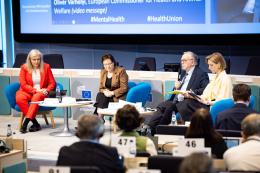
The European Economic and Social Committee (EESC) placed the emotional well-being of children and young people at the centre of its March plenary session, holding a major three-part flagship debate that brought together EU institutions, international organisations, civil society and youth representatives. Speakers urged a coordinated push for prevention, safer digital spaces and stronger community support to protect young people’s emotional well-being.
Europe is facing a pivotal moment. Social and economic inequalities, rapid technological change, anti-democratic forces and geopolitical instability are straining the foundations of the European project.
With democracy and civic space under mounting pressure, civil society organisations, human rights defenders and free media face growing constraints - from restrictive laws and disinformation campaigns to underfunding and public distrust. Deepening polarisation and eroding trust in institutions further undermine Europe’s democratic model.
In this opinion, the EESC calls on the European Commission to recognize that shrinking civic space and growing pressure on democracy and democratic values constitute structural barriers to poverty reduction and should be addressed in the implementation of the EU Anti-Poverty Strategy. To achieve SDG 1(No Poverty), the root causes of poverty must be addressed through a human-rights and democratic-resilience lens, shifting the discourse from providing charitable assistance to seeing poverty reduction as a shared public responsibility, as well as a fundamental human rights responsibility.
Download format:
Download — Γνωμοδότηση της ΕΟΚΕ: Shrinking democratic space as a barrier to achieving the Sustainable Development Goals in the European Union – placing civil society at the heart of Europe’s fight against poverty (SDG1)